Under One Roof, One Hope
At first glance, Ashaiman is all motion; trotro horns (same as Matatu in Kenya), roadside vendors, and the hard speed of a working-class town on Accra’s edge. It seems like an unlikely place for quiet acts of interfaith collaboration. But tucked walking distance from the Blessed Clementina Catholic Church compound, a Catholic-run rehabilitation center has become one of Ghana’s most unexpected spaces of religious coexistence, showing what can happen when survival leaves no room for division.
–Justice Baidoo and Efo Korku Mawutor
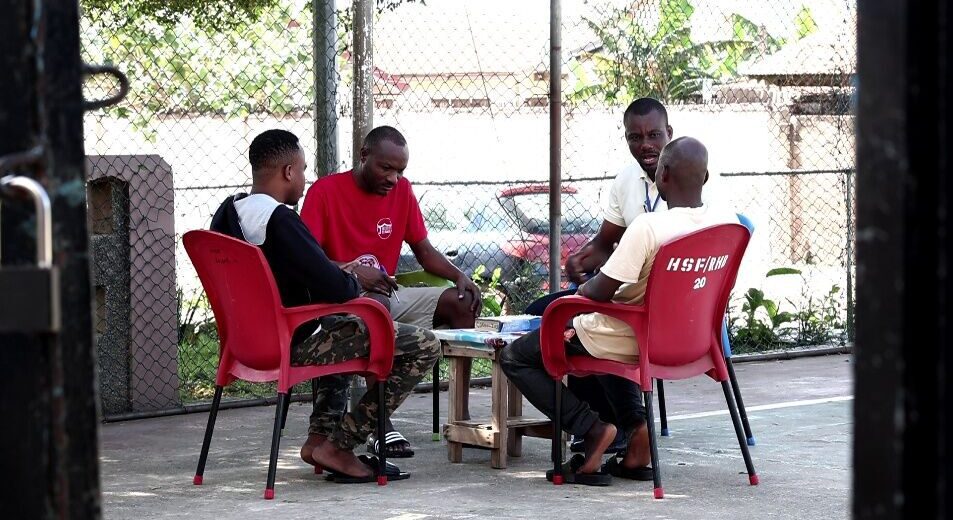
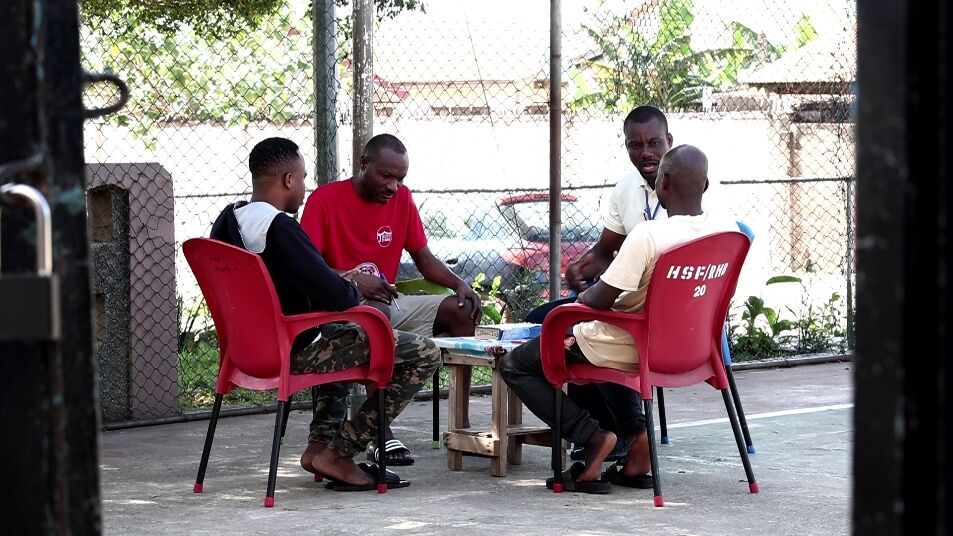
The morning light filters softly through the chapel windows at the House of St. Francis in Ashaiman, Accra. Inside, rows of men, some in simple T-shirts, some in faded trousers, sit in silence. They are people in recovery.
The air is still. The chapel smells faintly of incense and candle wax. It is time for morning meditation, a moment when everyone, regardless of faith, is invited to “connect with your higher power.”
Among them is Abdullah, a 39-year-old nurse from Tamale, Northern Region. He sits near the back. He came here three months ago, after years of struggling with a tramadol addiction. And it seems he came to the right place.
Though run by the Catholic Church, and he being a Muslim, the House of St. Francis was his last chance at rebuilding that life. “Since I came here for the last three months, I’ve worked on myself, and things have gotten better for me. They’ve even declared me fit, and I’m likely to return to Tamale soon. My life has actually changed,” he affirms to me.
“Before I came here, life was so bad for me. I was not able to manage my life. Talking of my finances, my association with my loved ones, my family and everything, I was not able to manage it just because of my addiction,” he recalls.
Every day, Muslims and Christians wake up under the same roof, share the same chores, and eat from the same kitchen.
Describing the daily rhythm, Abdullah says, “We have time that they normally come to open the gate for us to come out and do – like going to the dining hall, coming outside to work and other things. So, you cannot feel comfortable like your home. And here, when you come, you are coming for recovery. You are coming to rehabilitate yourself and go back to wherever you are coming from.”
He pauses, then adds, “I’m a Muslim. I practice Islam as my faith. But here, they don’t discriminate. They always ask us to go for their devotions, their meetings and everything, but they are okay with me saying my prayers.”
“We are all serving one God, just that we have different forms of worshipping Him,” Abdullah says simply. His friend Ibrahim, also a Muslim in recovery at the facility, agrees. He says, “Here, they don’t discriminate. They are okay with me saying my prayers.”
Ibrahim lived in La Paz, about 28km (17 miles) from Ashaiman. Though a degree holder, he was heavily addicted to Marijuana. He remembers how bad it was, “When I wake up in the morning, all I think about is what to get my addiction.” This is his second visit to the facility.
Now, he is on his way to full recovery. He believes the discipline and inclusivity at the House of St. Francis are to be credited.
“We have morning meditation,” he explains. “We go to the class and then we meditate to our higher power. The higher power is whoever you believe can help you to recover. For me, my higher power is Allah. For others, it’s God. We all go there together.”
The House of St. Francis
The House of St. Francis Clinic and Rehabilitation Center is a quiet refuge for men and women battling addiction. Founded in 2012, “with a single client,” the facility specialises in drug and alcohol rehabilitation for individuals with addictions to substances such as crack cocaine, heroin, marijuana, and similar substances. The facility was commissioned by Most Rev. Gaabriel Palmer-Buckle, the then-Archbishop of the Catholic Archdiocese of Accra, in 2014.
Walter Damien Asuong is the manager of the House. According to him, the House has successfully rehabilitated a little over 5,000 clients, with about 75 residents currently in the facility. The centre accepts people from all walks of life, “between the ages of 18 and 70 years,” though sometimes “we have minors coming in that are below 18 years and quite elderly people who are above 70.”
While most clients are Christian, Walter says, “we have Muslims coming in, we have traditionalists, and even people who don’t believe in the existence of God, the atheists also come in for help.”
Walter believes religion and spirituality are vital to recovery. “The main program we use is known as the 12 steps, and the 12 steps is a spiritual program,” he explains. “Principles like prayer, forgiveness, giving alms, they cut across almost all religions.” At House of St. Francis, Muslims can “pray five times a day if they want to.”
What makes the centre particularly strong, Walter says, is that most of the counsellors, supervisors, and managers were once people who used drugs and alcohol and have been able to come out for a considerable number of years.
He himself is in recovery. “I have always said that if I have the opportunity to let people know that once upon a time, I also used drugs and alcohol and have been able to stay clean and sober for over ten years now, it gives people hope.”
The Reality of Addiction Treatment in Ghana
Alcohol and drug use are on the rise in Ghana. Alcohol consumption alone is estimated at 23.3%, with the average Ghanaian adult drinking nearly 20 litres per year. Yet for most people struggling with addiction, help is far out of reach.
Formal rehabilitation services are concentrated in just a few psychiatric and teaching hospitals: Accra, Ankaful, Pantang, Kumasi, and Tamale, leaving vast areas without access to structured care. The shortage of trained professionals is acute, with barely 20 psychiatrists serving a population of nearly 30 million, some reports say.
Private and faith-based centres fill the gap, often relying on spiritual models like the 12-Step programme. While many find comfort there, others are deterred by cost, typically GHC2,000 or more per quarter, and by religious or cultural mismatches. Stigma remains another powerful barrier; few are willing to be seen entering a “psychiatric” facility.
A new Narcotics Control Commission Bill offers a glimmer of hope, reframing addiction as a public health issue rather than a crime. But for now, recovery in Ghana often depends less on policy and more on compassion from families, churches, mosques, and small community initiatives that refuse to give up.
Keeping a person for three to six months, feeding them, providing treatment and therapy, is costly. Walter believes religion is the solution. “Because we are a Christian facility, we are a not-for-profit organisation,” he says. “We are only charging what is necessary to take care of the client.” Compared to private and even some government-owned centers, “our charges are quite moderate.”
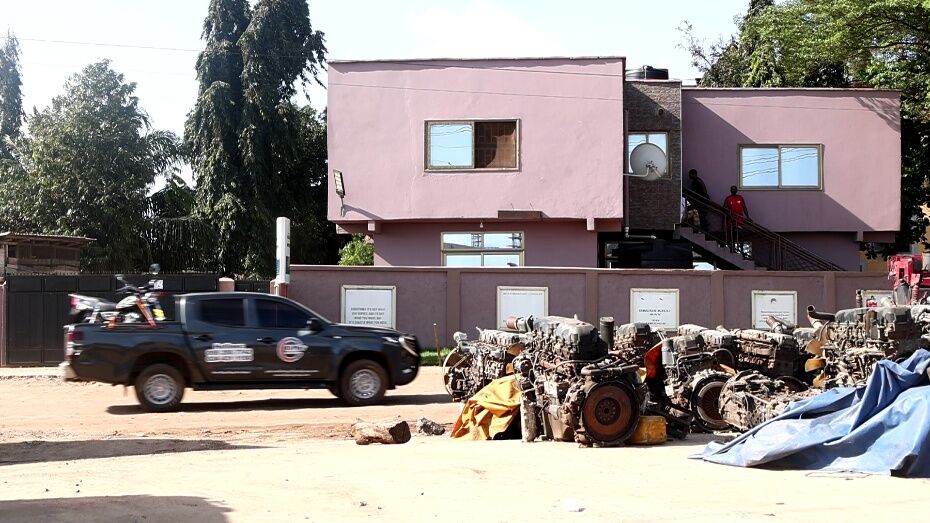
Affordability is crucial in a place like Ashaiman. 7.5% of the population is living in multidimensional poverty, with an average poverty intensity of 43.3%, according to Ghana’s Statistical Services. Of the 261 districts, Ashaiman Municipal is ranked second in terms of the proportion of population residing in houses with several dimensions of poverty. In the region of Greater Accra, it is ranked number 1 among 29 districts.
Walter and the House of St. Francis know this too well. Hence, as part of their corporate social responsibility, sometimes they “admit clients from Ashaiman who don’t have to pay. Every time, we have a quota that we take care of one or two people for three to six months without charging them.”
The House of St. Francis does not advertise itself as an interfaith model. It does something more powerful: it makes coexistence ordinary. In a country where addiction is rising faster than access to care, this quiet chapel in Ashaiman is a reminder that healing can be a bridge, and that sometimes the most practical interfaith work happens when people are simply trusted to recover, together.
This mini-series was proudly sponsored by the Shared Futures Programme of Kerk in Actie. Shared Futures partners with local actors to strengthen interfaith cooperation among young people, helping communities move from coexistence to collaboration through practical, everyday solutions.

Leave a Reply