How Faith Drives Youth Economic Inclusion In Ghana
Faith can be a force for more than worship; it can drive opportunity. Across Ghana, young people are leveraging faith-inspired programmes to gain skills, start businesses, and challenge unemployment. By linking spirituality with economic empowerment, communities are proving that youth inclusion is not just an ideal, it is achievable, sustainable, and transformative.
On a warm afternoon on June 12, 2025, a small group of young men and women gathered in Ashwerease-Daaman, a community in Ghana’s Eastern Region. Wearing aprons and holding hand-crafted bottles of soap, trays of beaded necklaces, and folders of apprenticeship receipts, these were not just trainees, they were future entrepreneurs, empowered not merely by scriptures or prayers, but by a faith that values the marketplace as much as the pulpit.
When True Worshippers Prophetic Dance Ministries began in 2013, its founder, Vincent Anowie, recalls, the mandate was “prophetic dance” and spiritual outreach. “We have been transforming and touching lives,” he explains. “Some of our activities include prison outreach, street outreach, school programs, and support for the physically challenged. Another key initiative we run is vocational skill training, where we provide practical ‘train-for-trade’ opportunities.”
By 2016, the ministry had officially transformed into an NGO, combining practical skills training with worship. For Anowie, this shift was deeply theological:
“Jesus chose those who worked in the fields, who were fishermen… even his earthly father was a carpenter, and Jesus himself learned the trade of carpentry. We aim to follow that example, taking a practical approach while staying rooted in spirituality.”
Today, the Train for Trade initiative has reached some 600–700 young people, with “40 plus people set up to start with a small-scale business,” Anowie says.
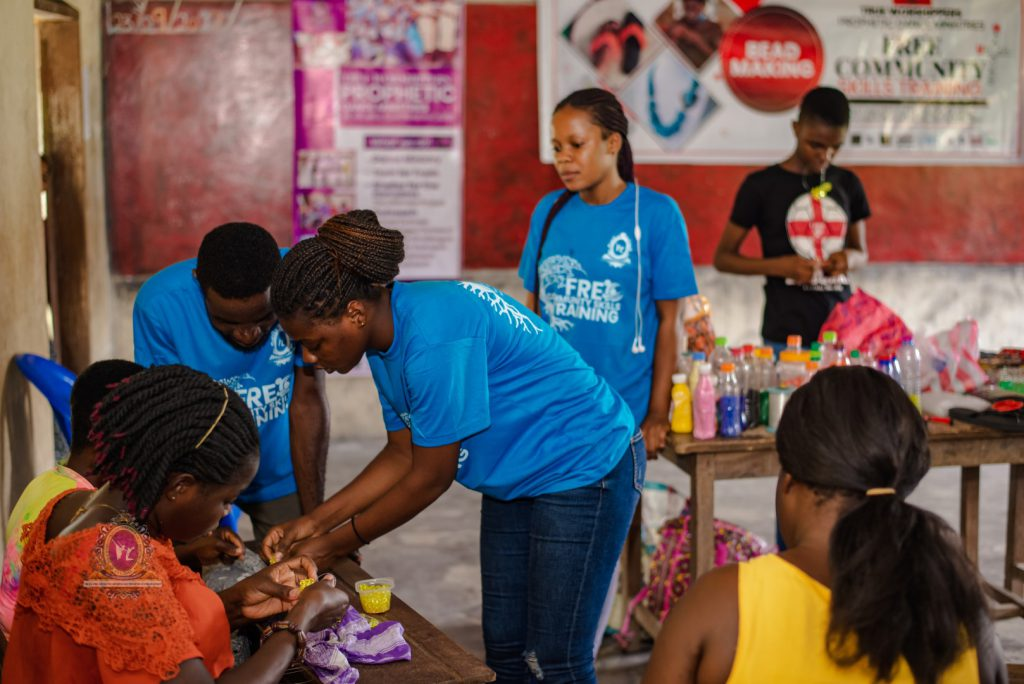
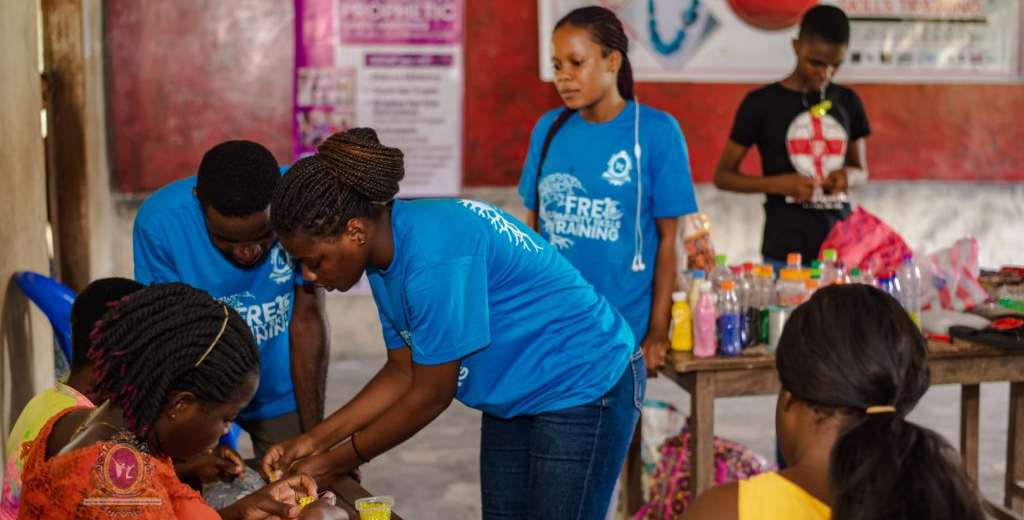
True Worshippers Dance Ministry trains rural women in beadmaking
Challenging the Secular Divide
A common narrative holds that religion ministers to the soul, while economics governs livelihoods, and that the two rarely intersect. Yet in Ghana, faith-based organisations are challenging this divide. For Felix Kofi Mawuko Dogbe, vice-president of True Worshippers, the connection is both natural and biblical:
“If I’m a body, spirit, and soul, the spirit is within the body. They go hand in hand. Why should I separate one from the other? I believe they should both grow together. It’s about balance. Just as you nurture the spirit, the same care should be given to socioeconomic activities.”
This integration of faith and economic empowerment is not a fringe idea. It reflects a growing movement of faith-based organisations that see skills training, entrepreneurship, and decent work as central to their mission.
According to the 2025 Labour Statistics Bulletin, Ghana’s unemployment rate stands at 14.7%, with young people aged 15–35 accounting for more than 60% of the unemployed. The Bulletin notes that, while tertiary enrolment has steadily increased, “skills mismatches and low absorption capacity in the formal sector continue to undermine youth employment outcomes.”
The challenge is not simply a lack of jobs; it is a gap between what is taught and what the market demands. “Youth unemployment and underemployment remain structural challenges,” the report observes, noting that most working Ghanaians are employed in the informal sector.
Faith-based organisations are increasingly stepping into this gap.
The VTF Programme
Long before the connection between faith and enterprise gained widespread attention, the Vocational Training for Females (VTF) Programme was demonstrating it in practice. Founded as a Christian-based NGO, VTF provides support services to strengthen Technical and Vocational Education and Training (TVET) delivery nationwide.
“Employment plays an important role in enhancing livelihoods, improving quality of life, and gradually reducing poverty,” the programme affirms. Its mission is to “promote viable employment opportunities through quality TVET support services to individuals, groups, and institutions via advocacy, networking, and capacity building.”
VTF’s work is guided by Christian values; honesty, humility, fairness, respect, and teamwork, which shape its partnerships with churches, vocational institutes, and industry. The organisation also supports initiatives like PRECEVID, a centre in Kumasi for instructor development and quality assurance in TVET, reinforcing the ecosystem that nurtures both trainers and trainees.
The Programme has quietly become a steady force in Ghana’s youth empowerment landscape, serving as a reminder that, as its team puts it, “TVET prepares the individual for life and gives them an orientation for good citizenship as much as it creates avenues for employment and wealth creation.”
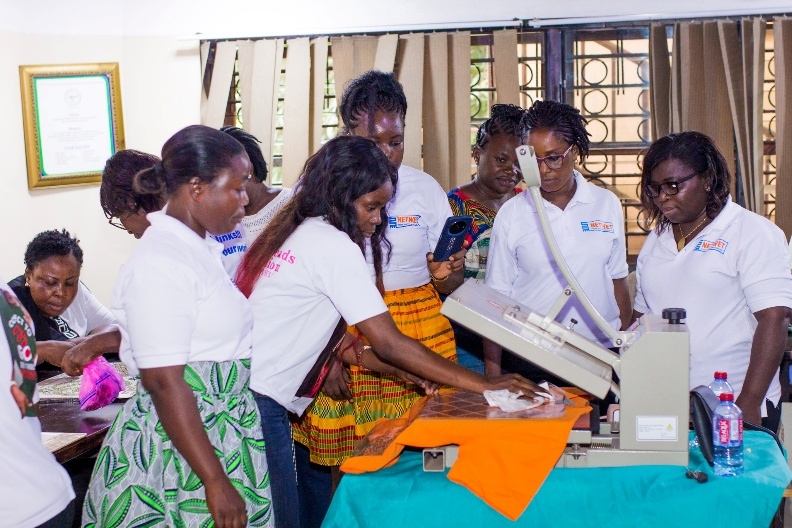
VTF trains young people in printing & beadmaking
In Ashaiman’s Middle East community, another faith-rooted project is redefining what it means to “minister” in the 21st century. The Blessed Clementina KNOLTA (BCK) Hope and Skills Initiative, established within a Catholic parish, blends prayer with practical skills to equip underprivileged youth and church members for the job market. Its dual mission is simple yet transformative: “to raise funds to support the less privileged and to equip young individuals with valuable skills for the job market.”
From the outset, BCK emphasized that faith and work are inseparable. Its founders note: “Through their ongoing support in a specific industry, benefactors can invest in the BCK Hope and Skills Initiative and have a long-lasting effect on people and communities, empowering the next generation of leaders.”
The pilot phase was ambitious, training young people in electrical work, hospitality, fashion, automotive refinishing, photography, videography, social media management, and even solar system installation.
What truly distinguishes BCK’s model is its holistic approach. Every trainee completes soft skills training in communication, teamwork, time management, leadership, and personal branding, alongside CV writing and interview preparation. The program’s manual describes this as “shared responsibility”:
“Beneficiary co-funding instils a sense of responsibility and value for the opportunity provided, while alumni contributions ensure support for future beneficiaries.”
True Worshippers’ Train for Trade
From churches in Accra to rural outreach in the Central and Eastern Regions, True Worshippers has extended vocational training to communities where economic opportunities are often limited.
“Some of the places we went to train,” explains Dogbe, “we were able to help participants refine their skills, and we also supported them with items to start their own businesses. We monitor them from time to time to help grow their enterprises.”
He shares a success story:
“A lady benefited from the detergent class. We realized she was able to produce products like ‘Akashia’ and Parazone. Her patronage was so high that she couldn’t meet the demand.”
Another trainee, a pastry student, continues to “make big time.” For Dogbe, success is measured not just by numbers, but by sustainability:
“Our major success is when we can set beneficiaries up and see that they have been able to sustain what we provided.”
Beneficiaries of the Train for Trade
Evelyn Andoh, a seamstress from a peri-urban community, joined the beading class of True Worshippers’ programme. She describes the training as “unique” and credits it with helping her expand her services and purchase an industrial sewing machine.
“I am a seamstress. I often turned to the internet to learn more about beading. Many training resources come with a fee. Despite this, I have successfully applied the skills I’ve acquired, introduced new projects, which have helped me earn additional income and purchase an industrial machine.”
Crucially, Evelyn also reflects on her faith:
“The word of God teaches that we have received freely, so we should give freely in return. There is a lady in my area who wanted to learn beading but didn’t have the resources. I decided to train her for free.”
Her work is also closely tied to family wellbeing:
“My business really supports my family. Recently, I used some of the money I made to buy books for the kids. If it weren’t for the business I run now, I wouldn’t know how I would have been able to afford them.”
Unlike purely economic interventions, organisations like True Worshippers combine spiritual care with livelihood support, running the “Train for Trade” programme alongside prayer, worship, and community outreach.
Dogbe explains that the programme begins with careful research:
“We try to find out what exactly the community needs and what is more marketable. We realised these particular things usually run through soap making, pastries.”
Many programmes end at graduation, but True Worshippers adds monitoring and follow-up:
“We give a grace period of three months. We monitor and evaluate. Some will leave, and indeed, the business is not thriving. Others make it look like their life depends on it.”
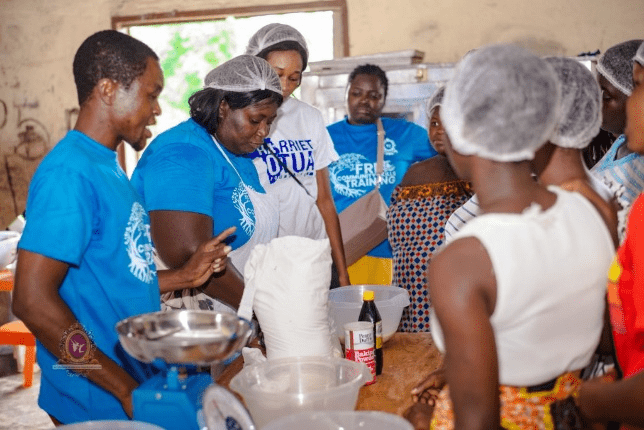
Cake-making training by True Worshippers Ministries
Overcoming Myths
The assumption that spiritual organisations should limit themselves to chapels, sermons, and charity is increasingly being challenged. As Anowie states plainly:
“We do believe in the spiritual aspect, and we do believe in the fiscal and all the practical aspects.”
Dogbe adds: “The human being is made up of spirit, soul, and body; while you are taking care of the spirit, it also falls on us to take care of the body as well.”
These perspectives challenge the long-held notion that religion and economics must operate in separate spheres.
When young people complete skills-training programmes without access to sustainable livelihoods or markets, the risk of unemployment, informal work, and social vices increases. Dogbe observes: “Most people who indulge in these social vices tend to blame it on unemployment, poverty, and peer pressure.”
Skill training offers a preventive pathway. Organisations like VTF emphasise that Technical and Vocational Education and Training (TVET) serve as a “master key” to accelerated development.
Faith-based empowerment is not without its obstacles. “Our major problem is funding,” Dogbe explains. “We are torn between sometimes taking money from our own pockets or soliciting funds from friends and family.”
The are also structural challenges within Ghana’s TVET ecosystem, including outdated curricula, weak instructor competencies, low literacy and numeracy levels, poor infrastructure, and weak industry linkages.
Despite these hurdles, both models are responding in practical and innovative ways. True Worshippers plans to establish a “Tent Project;” a 110-acre community training centre that will bring youth from across Ghana and Africa to learn skills full-time.
What Success Might Look Like
Evelyn Andoh summarises the transformative impact of the training on her life: “This training has empowered us by teaching practical skills. The training was offered for free. It significantly shaped me.”
Across Accra, Kumasi, and beyond, the pulpit has extended its reach into workshops, production lines, digital platforms, and small-business incubators. In doing so, it is opening doors for young people who once thought the pulpit and the marketplace belonged to two separate worlds.
Perhaps, they never did.
This mini-series was proudly sponsored by the Shared Futures Programme of Kerk in Actie. Shared Futures partners with local actors to strengthen interfaith cooperation among young people, helping communities move from coexistence to collaboration through practical, everyday solutions.

Leave a Reply