Communities have developed faster than the development sector itself’
When it comes to locally-led development, the devil is in the details. This is according to Grace Maingi and Caesar Ngule of the Kenyan Community Development Foundation (KCDF), in a conversation with the leaders of a real pioneer organisation in this field. According to them, giving from the community itself is the most important key to truly community-led work and equality. ‘International solidarity must be complementary to local solidarity.’
Text: Eunice Mwaura and Marc Broere
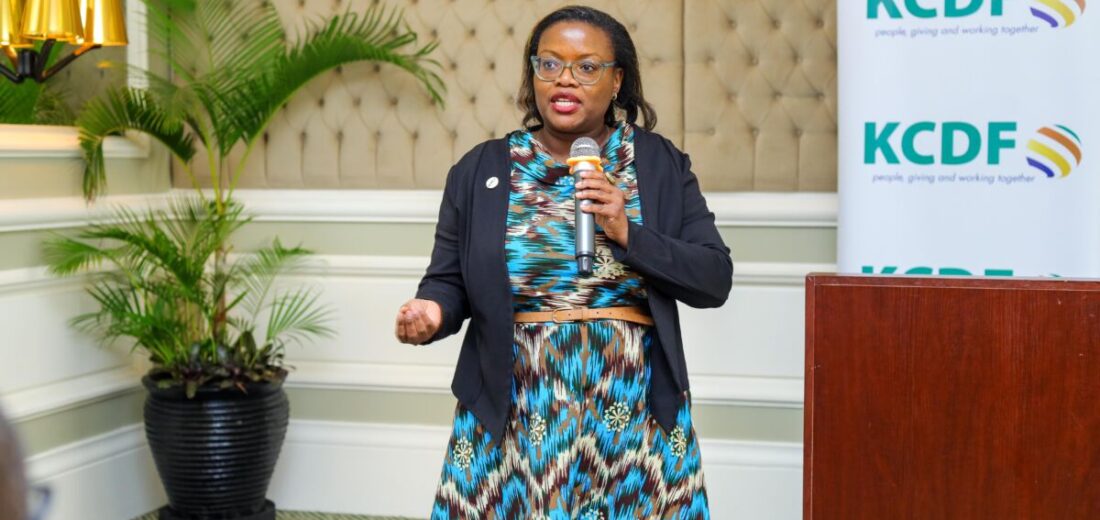
Neither of them has to think long about the opening question of the conversation. Is the role of the community still underestimated in the world of development cooperation? ‘Absolutely,’ affirms Grace Maingi, Executive Director of the KCDF.
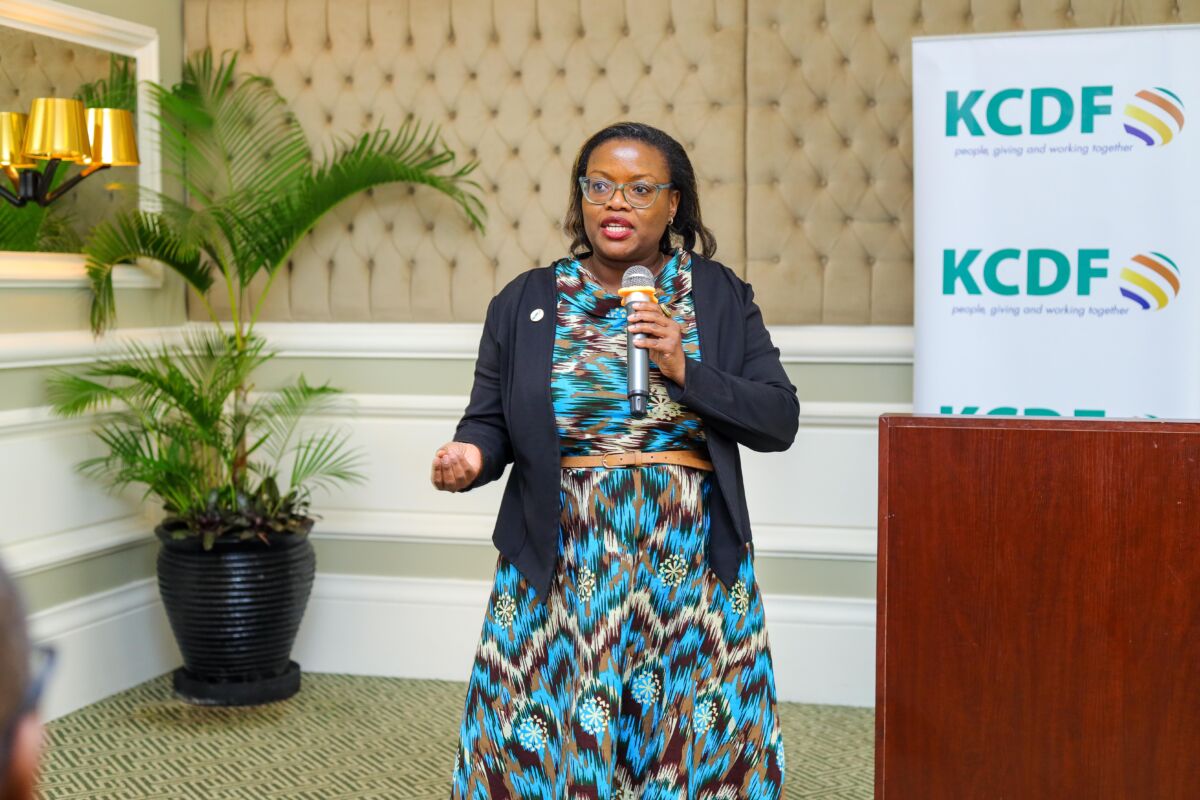
‘Even today, conversations about development often assume that outsiders or people in urban areas know the solutions, rather than consulting the community itself. That is why we still see project proposals drafted and interventions planned without input from the very people for whom these projects are intended,’ she says.
‘You can also still see this attitude within the language use as well. People are called beneficiaries, implying that something is being done for them rather than with them. As if they are passive receivers instead of active participants in their own development.’
Caesar Ngule, Programme Director of KCDF, nods: ‘When foreign aid to Africa started, most countries had just gained independence. The prevailing attitude was that development aid meant doing things for others, such as building infrastructure or providing water, because it was assumed that local people did not know what was best for them.
‘That mindset has not shifted enough, even as development cooperation has become a professional sector. In our work at KCDF, we see countless communities driving their own development through local philanthropy and by influencing government. Increasingly, it feels as though the development sector is the one playing catch-up,’ he states.
More and more development organisations now claim to be ‘community-led.’ In fact, it has almost become a buzzword in the sector. ‘The ambition and good intentions are certainly there,’ says Maingi. ‘But if the community truly leads you, then how does that show up in your work and in the way you engage with the people you serve?
‘It must go beyond being a fancy phrase in reports or plans to real action. The real challenge lies in the details: What does it actually mean to be community-led? Are we willing to adjust our systems and processes accordingly?
She continues: ‘Because if the community genuinely drives your work, then your role as a funder shifts. You are no longer the one doing everything. You become a facilitator, working alongside the community, but no longer leading the process. That leadership belongs to them.’
The Kenyan Community Development Foundation (KCDF) is a pioneer in championing community-led development. Ahead of the conversation, Ngule leafed through From Seed to Institution, a KCDF publication that documents the organisation’s journey since its inception in 1997.
KCDF was born out of frustration with the aid system of the 1990s. At the time, Kenyan professionals working with institutions such as the World Bank, the United Nations, the Government of Kenya, and the private sector had witnessed firsthand how donor funds were managed.
Too often, a large share of resources was lost in processes before reaching communities, and the little that did trickle down was beyond the communities’ control. As a result, projects often failed to create the impact donors had envisioned, where it was most needed.
With largely unrestricted support from the Ford Foundation and the Aga Khan Foundation, KCDF’s founders were able to establish an organisation with a bold vision: Kenyans giving and working together for shared prosperity. Working with communities is something Ngule reflects on every day, a process he believes requires constant self-examination.
For example, how do you know when a community is simply telling you what they think you want to hear? How do you avoid unintentionally reinforcing a top-down approach, even when you believe you are being inclusive and participatory?
‘You have to build relationships where partners feel safe enough to give you honest feedback,’ Ngule advises. ‘Always be mindful of the power you hold as a funder, an intermediary organisation, or a development professional.
‘And what happens when the community’s priorities do not align with yours? Are you still willing to provide resources to support them and then step back?’ he asks. ‘No one can claim the title of a ‘truly local’ development organisation by default.’
He continues: ‘That recognition is earned when communities themselves see you that way; through your relationships with them, your understanding of their realities, and your ability to align your support with their priorities.
‘Being founded in Kenya, or simply opening a country or regional office here, does not automatically make an organisation locally led,’ he explains. ‘We have to go beyond offices and build equitable processes, meaningful relationships, and community-centred investments.
‘Before launching any initiative, whether a new programme, an expansion into a new area, a scale-up, or an innovation, we must ask: will this leave the community stronger, with more power to solve its own development priorities in a rapidly changing world?
‘Every organisation must continually examine whether it is truly needed, and where exactly it adds value in the development ecosystem. At KCDF, this is an ongoing reflection,’ he adds, ‘ensuring we focus on what we do best, complement rather than duplicate others’ work, and maximise impact through leverage and collaboration.’
According to Ngule, one of the most critical conditions for truly community-led work is that collaboration must go beyond a transactional, financing-only relationship. He prefers to refer to the communities and community organisations KCDF works with as allies and partners rather than beneficiaries waiting to receive support.
‘We focus on building long-term, collaborative relationships where our allies know that the partnership is not tied to a single project or budget cycle,’ he explains. ‘It is grounded in long-term solidarity and a shared commitment to accelerating the achievement of their priorities.’
Unearmarked funding, Ngule notes, is also crucial for genuine collaboration. ‘KCDF itself is increasingly receiving unearmarked funds from our own donors. So why should we dictate to our partners how they spend such funds? The more funders embrace this form of trust-based giving, the more we can address power imbalances and engage in true community-led development.’
Another key piece of advice Ngule offers to organisations striving to work in a community-led way is to invest time in truly understanding the communities they serve. ‘Get as close as possible,’ he says.
‘A community is made up of people with diverse backgrounds, levels of education, and experiences. You need to hear a variety of voices to co-create solutions; not only from community leaders but also through everyday conversations in local gathering places and social spaces.’
What sets KCDF apart from many organisations working on localisation is that it goes a step further by linking localisation to domestic resource mobilisation and community philanthropy.
Over the years, KCDF has learned through experience that communities are far more likely to own and sustain projects when they have actively contributed to making them a reality—whether through financial support, in-kind contributions, or other meaningful engagement.
For Ngule, embracing this approach was a learning curve. ‘When I joined KCDF, my very first assignment was to run a local fundraising programme aimed at helping our partners raise at least fifty percent of their funds locally,’ he recalls.
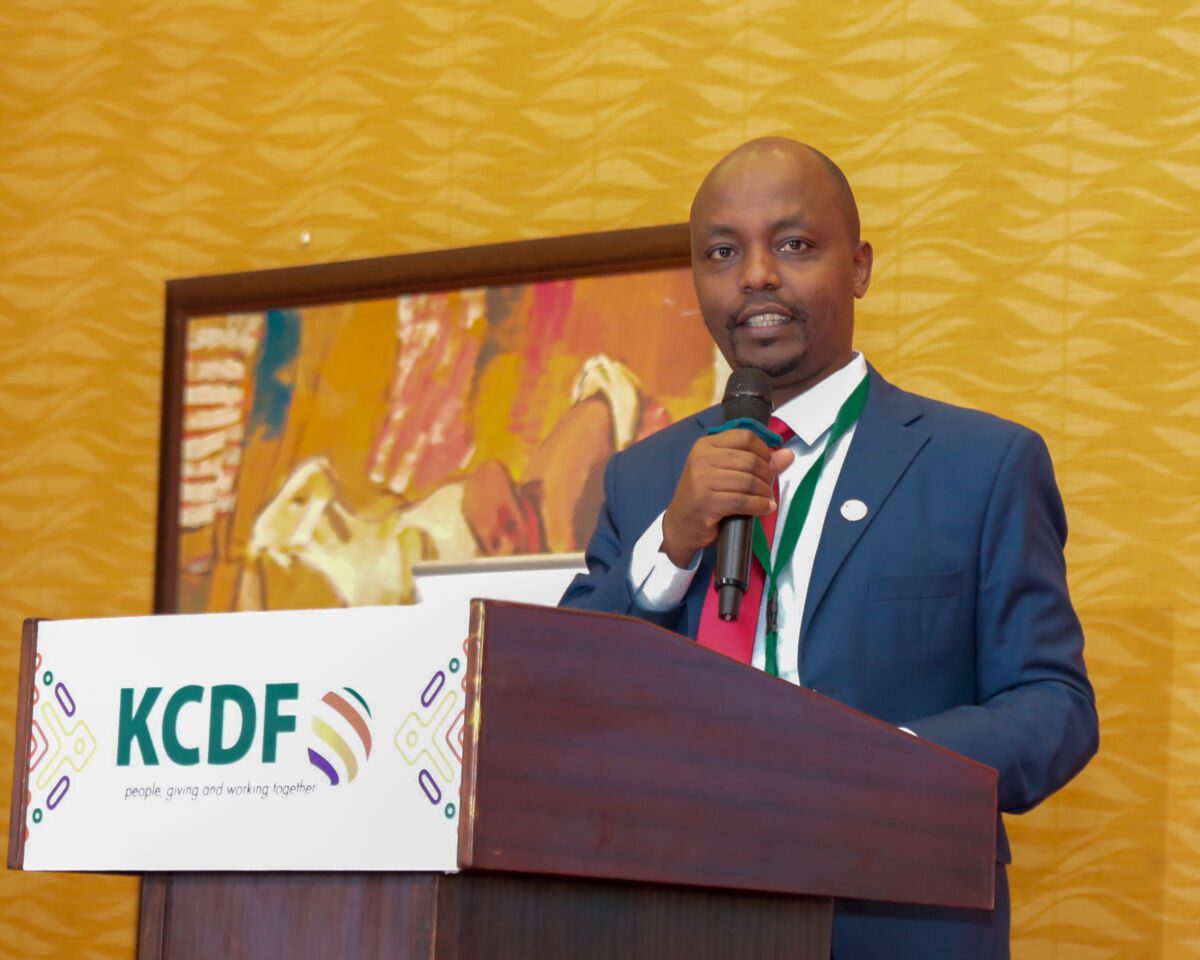
‘Honestly, after two weeks, I almost wrote my resignation letter. It was such a foreign concept to me. I had grown up with the mindset that money for projects always came from outside. But after a month or two, I began to thrive. That experience has completely reshaped how I view development.
‘It is not just about finding money, it is about believing that the resources exist right here, within our communities,’ he explains. ‘I always say: ten shillings raised locally in Kenya is worth far more than the same amount sourced abroad.
‘The difference lies in the depth of the connection. People give because they truly understand the problem or value the solution being implemented. That does not mean I dismiss international solidarity, far from it.
‘It remains vital. But it should complement, not replace, local solidarity. When communities and countries build that layered support system, that is when true community-led development becomes possible.’
Grace Maingi nods in agreement. ‘For us, the focus is on helping communities—whether individuals, groups, or organisations—recognise that everyone has something to give. No one can truly say they have nothing to offer.
‘Even if it is not financial, your expertise, time, or presence is valuable. The key is to help people see how they can give, and where their contributions can make the greatest impact.’
She continues: ‘Giving is also about stepping out of your comfort zone. That is why we offer people different options: Can they give in kind? Contribute financially? Share their time or expertise? And beyond that, how can that giving be sustained to address a community problem in a meaningful way?
‘A big part of encouraging giving is about showing impact. People need to see where their contribution is going and what it is helping to achieve. In Kenya, for example, people are very willing to support a child’s education,’ she explains.
‘It is tangible—you want this child to go to school and have a better life. What we are trying to do is broaden that vision. What if, instead of supporting just one child, we also invested in the systems and structures that enable many children to access education? That is where sustainability begins.
‘We offer programmes to make this possible. Individuals and groups can, for instance, contribute to an endowment fund that grows over time and funds multiple scholarships,’ she adds. ‘Alternatively, they can support citizen engagement efforts, or even personally take part in dialogues with county and national governments, to shape education policy and contribute to strategies that ensure access to education for generations of children.
‘At KCDF, we are always searching for pathways that make it easier for people to join this wider community of giving and engagement,’ Maingi explains. ‘Participation is contagious—when one person gives ten or twenty shillings, another may feel inspired to give fifty or a hundred.
‘And when people see others contributing toward the same goal, a powerful sense of togetherness emerges. They realise they are not alone; that they are part of something bigger. That collective energy is what truly drives change,’ she states.
Community giving, Ngule adds, is deeply aligned with African traditions. ‘That culture of giving and solidarity runs throughout Africa,’ he says. ‘Across the continent’s many cultures, values of sharing, mutual support, and collective responsibility are deeply rooted.
‘In some languages, there isn’t even an exact English word to capture it, but every African culture has a concept that predates formal education or the colonial systems of charity.’ Western aid, Ngule warns, can sometimes unintentionally threaten this culture of giving and collective responsibility.
He shares an example: ‘We worked with a community where residents had agreed to dig ditches for a water pipeline. Many did not have money, but they had time and labour and were willing to offer both. There was a strong sense of community spirit driving that project.
‘Then, in a neighbouring village, another donor arrived and began paying residents to dig ditches for a similar pipeline. Almost overnight, the spirit of collective responsibility in our community began to unravel.
‘People started asking why they should volunteer when others were being paid for the same work. Interestingly, that donor could not sustain their approach over the long term.
‘We must protect and nurture the culture of Ubuntu. If we are not careful, the very systems we create risk eroding our greatest strength: our ability to stand on our own and sustain change for the long term.’
Maingi nods. ‘Because money easily translates into buying things, it is often seen as more valuable. Time and knowledge feel less tangible—you cannot ‘cash in’ the hours someone has given in the same way you can a cheque. Yet that contribution is just as important.
‘Someone who donates their time and skills to a project begins to feel true ownership. It becomes their project. That level of engagement is very different from someone who contributes money from thousands of miles away. Our role is to validate all forms of giving and to remind people that generosity is not measured only in shillings.’
Ngule adds a concrete example of how KCDF puts this principle into practice. ‘Take the case of digging a ditch or building a school,’ he explains. ‘The community knows exactly the market value of the work. For a ditch, for example, they measure in units of seven meters and know it costs three hundred shillings per unit if you hire labour.
‘So, if a community member voluntarily digs those seven meters, we record that as a three-hundred-shilling contribution. In effect, they have monetised their labour, and we capture that in our accounting as part of the project’s cash contributions.
‘‘Our goal is not just to keep records but to actively dismantle power dynamics. We want to challenge the perception that someone who donates money gives more value to a project than someone who contributes their time or knowledge. Recognising all forms of giving reinforces the idea that everyone is an equal partner.’
As we wrap up the conversation, we ask them for a final tip for organisations that genuinely want to work in a locally led way.
‘One of the most important things,’ Maingi says, ‘is to allow communities to articulate what they are already contributing. Do not come in with the mentality of, ‘We have the money and expertise, and we are here to deliver. Instead, start with an honest conversation: You want to join in addressing this problem. That approach acknowledges and respects the efforts communities are already making.
‘Ask: What are they already doing to address the problem or seize the opportunity? What else could you do to complement those efforts? How can you build on what already exists? I encourage organisations to be brave enough to have these conversations. This is how you begin to create a level playing field and dismantle harmful power dynamics.’
Box 1
Kenya has been in the news frequently over the past year due to protests led by young people, the Gen-Z, against President Ruto’s policies. This generation appears deeply socially engaged. Does their activism align with the principles of Ubuntu and community philanthropy? Grace Maingi believes it does.
‘Every generation expresses itself differently,’ she says. ‘What we see in Gen-Z is that the sense of community is still very much alive—it just takes new forms.
‘Their protests against the government were, in many ways, community philanthropy in action. There was trust: young people sent mobile money to others they had never met, to support those injured in the protests. Those who received the funds reported back on how the money was used. Others translated the Finance Bill into local languages or created USSD codes to enable money transfers without internet access.
‘This is solidarity. This is generosity. This is community—just expressed differently from what my generation is used to,’ Maingi reflects. ‘We grew up with harambees and passing physical envelopes around to collect funds. Gen-Z does it through social media, mobile money, and digital organising—but the heart behind it is the same.
‘And just like any generation, they inspire one another: Who is giving? Who is showing up at the protests? I want to be part of that. The method may have changed, but the principle is unchanged—when they see human suffering, they act.’
.
Box 2
Grace Maingi describes community philanthropy as the practice of mobilising both cash and non-cash resources to meet a community’s needs. It is about individuals coming together to offer their time, knowledge, and financial resources to tackle local development challenges. Community philanthropy lies at the heart of the work of community foundations like KCDF, whose mission is to ensure that locally available resources are directed toward local priorities.
KCDF is also a partner in the Giving for Change programme, funded by the Dutch government under the Power of Voices partnerships. The initiative seeks to strengthen local philanthropy as a driver of community-led development. Other partners in the program include the Global Fund for Community Foundations (GFCF), Africa Philanthropy Network (APN), Wilde Ganzen, Comuá Network, Coordenadoria Ecumênica de Serviço, and the Dalia Association.

Leave a Reply