From Tolerance to Collaboration
Ghana is often celebrated for peaceful Christian–Muslim coexistence. Yet coexistence is not the same as collaboration. Many people still live their faiths apart, with goodwill softened by silence and deeper engagement left untouched. That is why structured interfaith efforts matter; not as performances of unity, but as practical partnerships that solve real problems.
Ghana is known for its peaceful coexistence between Muslims and Christians, yet many people still live their faiths apart. From shared meals during Eid and Christmas to interfaith statements issued by religious leaders in times of national crisis, coexistence has become part of Ghana’s social fabric.
Scholars like Eric Oduro Wiafe note that this peace is rooted in Ghana’s “inherently tolerant and welcoming social climate” and government policies that protect freedom of worship. Yet, as he observes, this harmony is often more a product of cultural coexistence than active interfaith engagement.
Recently, Ghana’s official National Day of Prayer and Thanksgiving was observed on July 1st, the nation’s Republic Day. It was a public holiday for the country to reflect, give thanks for blessings, and renew its commitment to national prosperity and unity. The observance included prayers from Ghana’s major faith communities: Christian, Islamic, and Traditional religions, promoting interfaith harmony.
At this event, in his speech, President John Dramani Mahama, himself a Northerner and a staunch Christian, is reported to have said, “In Ghana, churches and mosques don’t compete for dominance; they coexist in mutual respect and dignity.”
Despite Ghana’s long record of peaceful coexistence, many still live their faiths apart. Dr. John Azumah has described the Christian-Muslim relationship in Ghana as a “dialogue of life,” friendly and respectful, but rarely intellectual or theological.
While Christian and Muslim neighbours may attend each other’s weddings or festivals, deeper conversations about faith, cooperation, and shared social responsibility remain rare. As a result, mutual goodwill often coexists with quiet misunderstanding.
This underlines why structured interfaith efforts, like youth mentorships and joint community initiatives, such as the Radiza Foundation Mentorship Initiative, are vital to move Ghana’s religious coexistence from tolerance to true collaboration.
The Radiza Mentorship Initiative
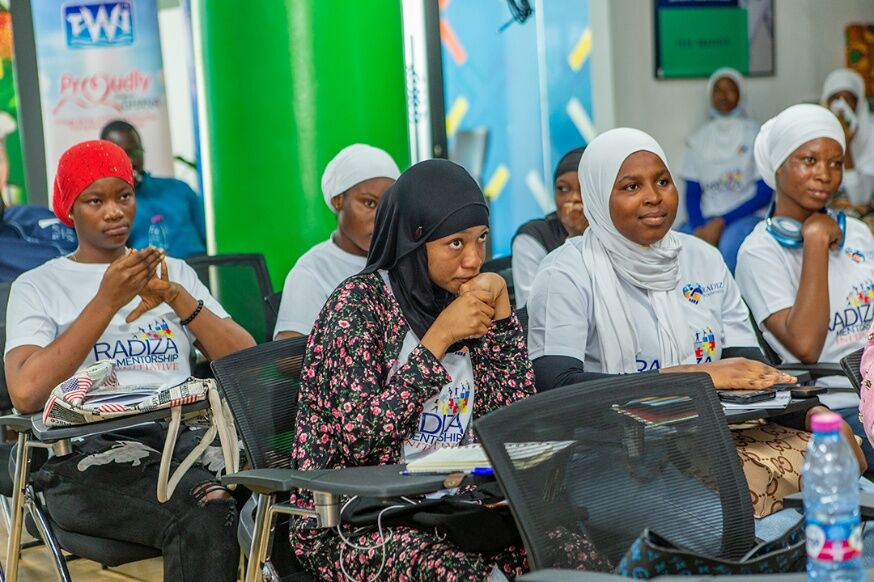
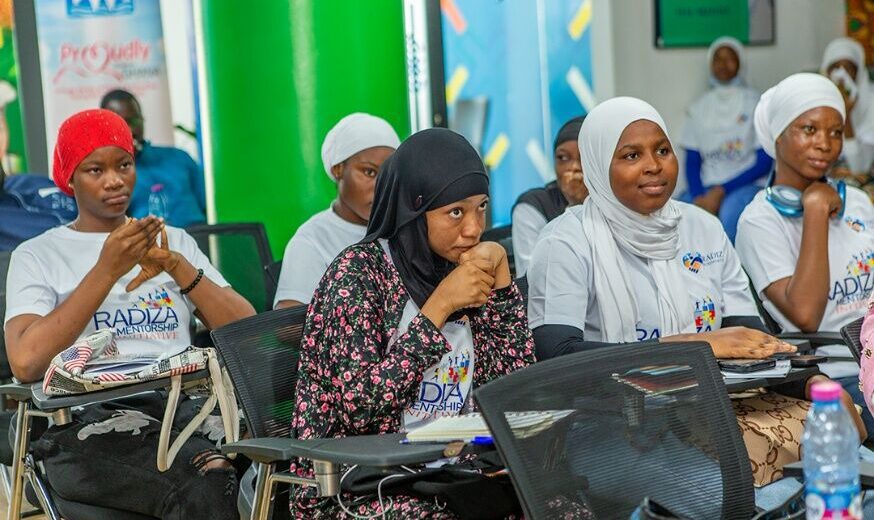
July 17, 2025. The conference room at the ALX Hub in Accra buzzed with a warmth that had little to do with the afternoon heat. Rows of eager young faces, all from Sabon Zongo, leaned forward, pens poised, eyes wide with curiosity.
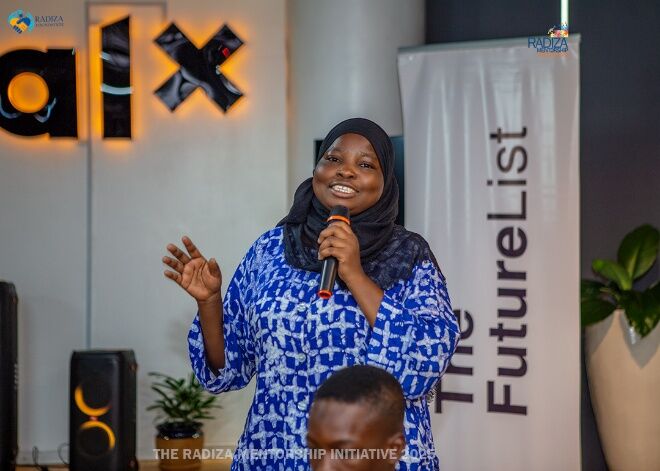
At the front stood a woman in a calm but commanding poise, her smile both confident and familiar. Her name, Rabiatu Yakubu, founder and executive director of the Radiza Foundation, is now on a journey to changing the narrative of my community.
Around her were mentors, some in hijabs, others in suits. There was Smart Takyi-Nixon, a Christian mentor who had become a favourite among the mentees for his easy laughter and candid advice. Nearby was Tayiba, a young Muslim woman mentor. The mix of accents, faiths, and personalities created a rhythm that pulsed through the room.
For many of the mentees, all Muslim children from various Makaranta [Islamic community schools] in Sabon Zongo, a deprived slum community in Accra, this was their first time outside the community for a formal mentorship program. Some had arrived unsure of what to expect. But by midday, the shyness had melted away. They asked questions, shared their dreams, and debated ideas about what it meant to be responsible citizens.
How did it all start?
For Rabiatu Akibu, the story of the Radiza Foundation began in the narrow lanes of Sabon Zongo, where she was raised by a single mother who taught her resilience and empathy. “I was born and raised in Sabon Zongo, a deprived urban area in Accra,” she recalls. “I am committed to changing the narrative of my community, letting young people believe in their power to change their lives and transform their communities.”
Her vision for the Radiza Foundation grew out of that conviction that young people, especially those from marginalised backgrounds, could rewrite their own stories if given the right support. The Radiza Mentorship Initiative was her way of giving back.
But from the start, Rabiatu was intentional about inclusivity. “I looked for humans,” she says simply. “I didn’t look for Christians or Muslims. I looked for people who believed in what I was doing, and then we were able to work it out.”
For her, coexistence is a lived experience. “Growing up in Sabon Zongo taught me that peace doesn’t mean sameness,” she explained. “It means understanding and respect.”
By creating spaces where Muslim and Christian mentors could work together for a shared goal, Rabiatu hopes to model a new kind of community leadership, one built not on religious identity but on purpose and compassion.
That philosophy guided her as she recruited mentors from different faiths, including Christians like Smart Takyi Nixon, who shared her passion for youth empowerment.
Mentors from different faiths work together
For Smart, stepping into the Radiza Mentorship Initiative as a Christian mentor felt like coming full circle. A communications professional and playwright, he had spent over a decade working in advocacy and volunteering, much of it focused on empowering young people.
“We all need a shoulder to stand on,” he says. “When three people are standing, the one in the middle can choose not to walk. He can rest his hands on the shoulders of the ones on his left and right, and he will go exactly where they are both going.”
That belief in shared strength drew him to Rabiatu’s vision for the Zongo community. “I learned brotherhood from my Muslim brothers,” he reflects. “They gave me food without asking me what type of religion I had.”
Having grown up in a Zongo community himself, Smart saw the project not as a religious outreach but a human one. “Advocacy is not religious-based,” he insists. “It’s about the willingness to hold another person’s hand and say, I will walk you through the stream so you can get to the other side.”
He remembers one small but meaningful moment in the 3-day programme very vividly; the Friday, the 2nd day of the programme, they had to pause the mentorship session so the mentees and Muslim facilitators and mentors could perform their prayers.
To him, “That wasn’t an interruption,” he smiles. “It was respect.”
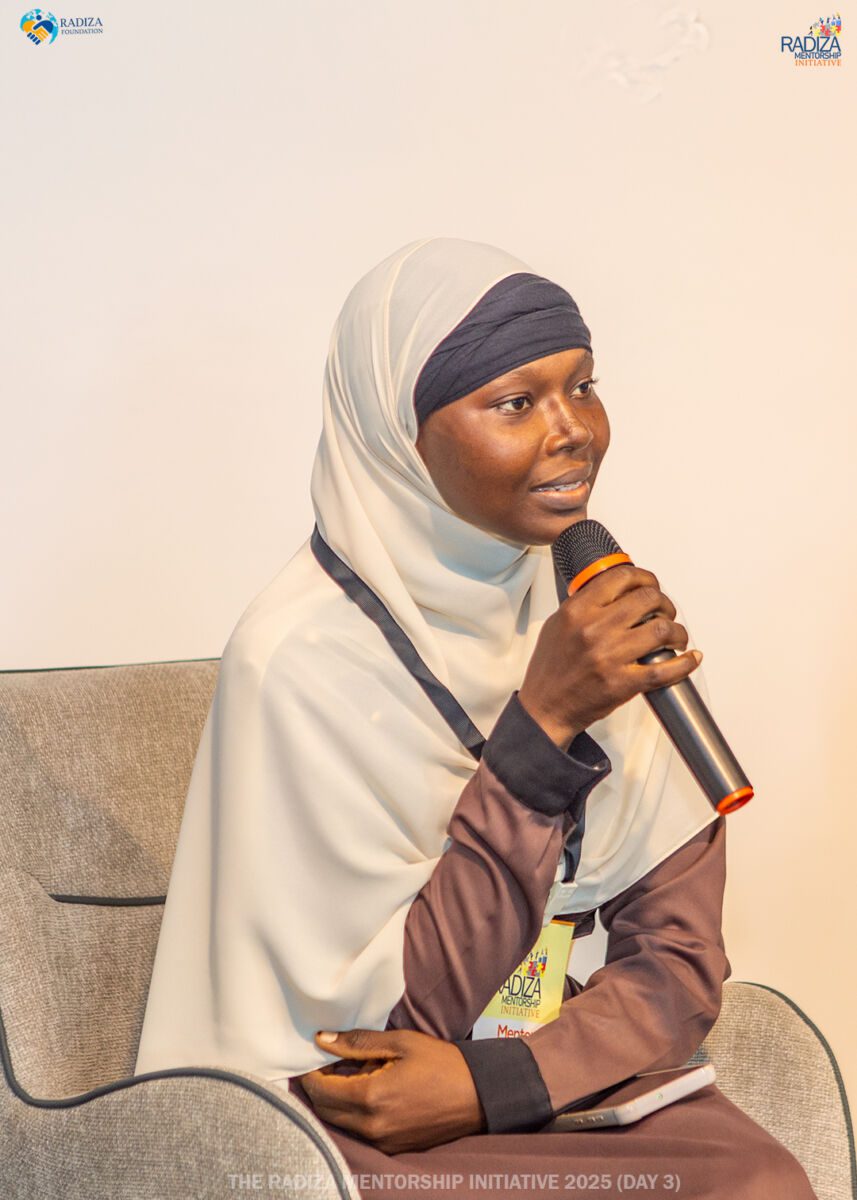
One of the Muslim mentors on the programme was Tayiba Hellah, a professional teacher. She saw herself reflected in the bright, curious faces of the girls who reminded her of her own journey growing up in Sabon Zongo.
“Most of them have never sat this close to professionals who believe in them,” she says. “I want them to know that where they come from does not limit where they can go.” Working alongside Christian mentors challenged and inspired her in equal measure.
“You realise that despite the differences in ideologies—faith ideologies—these people still respect your faith. I mean, when it’s time to pray, you can go. When it’s time to do something else, you can say, “Oh, I’m fasting, I don’t think I can really do this,” and they understand. And so, you are also able to understand them when they have to do certain things related to their faith. I don’t think I’ve had so many problems,” Tayiba says.
Interfaith harmony, she explains, has always been a way of life in her family. “When my mom travelled to the north and there was nobody to take care of me, it was a non-Muslim woman we lived with who gave me money for classes and food when I returned,” she recalls. “Even now, she still asks my mother and sisters to visit her because she’s alone. My mother has always taught me a lot about coexisting with everybody,” she added, with a smile.
Clear and measurable impacts
Ali Ibrahim is one of the local Imams who supported the programme and provided his students in his ‘Makaranta’ to participate in the mentorship programme. He recognises the impact on his students. “Just recently, when my kids were involved in such an event, I could see numerous changes, and I can see based on their input,” he confirmed to me.
The Imam expressed strong support for Muslim and Christian youths working together. He sees the religious affiliation as inconsequential to the vision of raising responsible youths from deprived communities.
“Look at the impact. For the religious aspects, you just put them aside. Look at the impact on the generation.” He emphasised that collaboration across faiths strengthens the community: “They are helping us, we are helping them, and together we build. We build a community that all of us would be happy to see.”
Hanif Abdul Kudus is one of Imam Ali’s students who benefited from the programme. He described his experience with the Radiza Mentorship Initiative as transformative. During the three-day program, he learned key skills that he believes will guide his future, including “goal setting, trusting your mentor and helping your community in some dangerous situations.”
Hanif also found a mentor who could specifically help him pursue his dream of becoming an accountant. He said, “I found someone who can help me become an accountant. And it’s a she. She’s a very good person. She has been helping me through my academics.”
Even at this young age, he finds it interesting that non-Muslim mentors are willing to help children like him. “I think it’s very interesting because they were putting the differences aside to bring up teens who are not part of their religion to make good adults.” He added, “Since our mentors are putting the differences aside to bring up the children in our community, I think others can do the same. It’s not really hard.”
His classmate, 17-year-old Bikisu Hussein, agrees with him. She is even more excited that the founder of the programme came from her community. She said, “Being part of the Radiza Mentorship Initiative has been very interesting. I feel proud that someone from my community has been thinking of us, the youth here, to be able to organise a mentorship program for us.”
During the program, she learned essential skills that she believes will shape her future, saying, “I got to learn, I have to prioritise smart goals in my life. And also, I’ve learned to be able to work on my confidence… And I’ve learned that getting a mentor is also a good thing in my life.” She found a mentor, Tayiba, who guided her in her passion for poetry and shared her own challenges.
On the impact of mentorship on her outlook, Bikisu shared, “After getting the mentor, my future is like, I keep dreaming… when I get to where I want to, I still want to go further… my future is already like, it’s not all that stable, but I’ll keep moving forward.”
In a country often held up as a model of religious tolerance, the story unfolding at the Radiza Mentorship Initiative is a powerful reflection of Ghana’s broader coexistence. Here, young Muslims and Christians are not merely tolerating one another; they are working side by side, learning, laughing, and sharing meals as they build a future defined by collaboration rather than creed.
For Rabiatu Akibu, the founder of the Radiza Foundation, this harmony is rooted in a simple truth. “If God wanted us to be one religion,” she says, “He would have made us one.”
This mini-series was proudly sponsored by the Shared Futures Programme of Kerk in Actie. Shared Futures partners with local actors to strengthen interfaith cooperation among young people, helping communities move from coexistence to collaboration through practical, everyday solutions.
Leave a Reply