School offers girls in Kibera ticket out of cycle of poverty
For many girls in Kibera, finishing school does not open doors, it closes them. With limited access to higher education and few job opportunities, uncertainty quickly sets in. But through skills training and mentorship, a growing number are finding new pathways to independence and purpose.
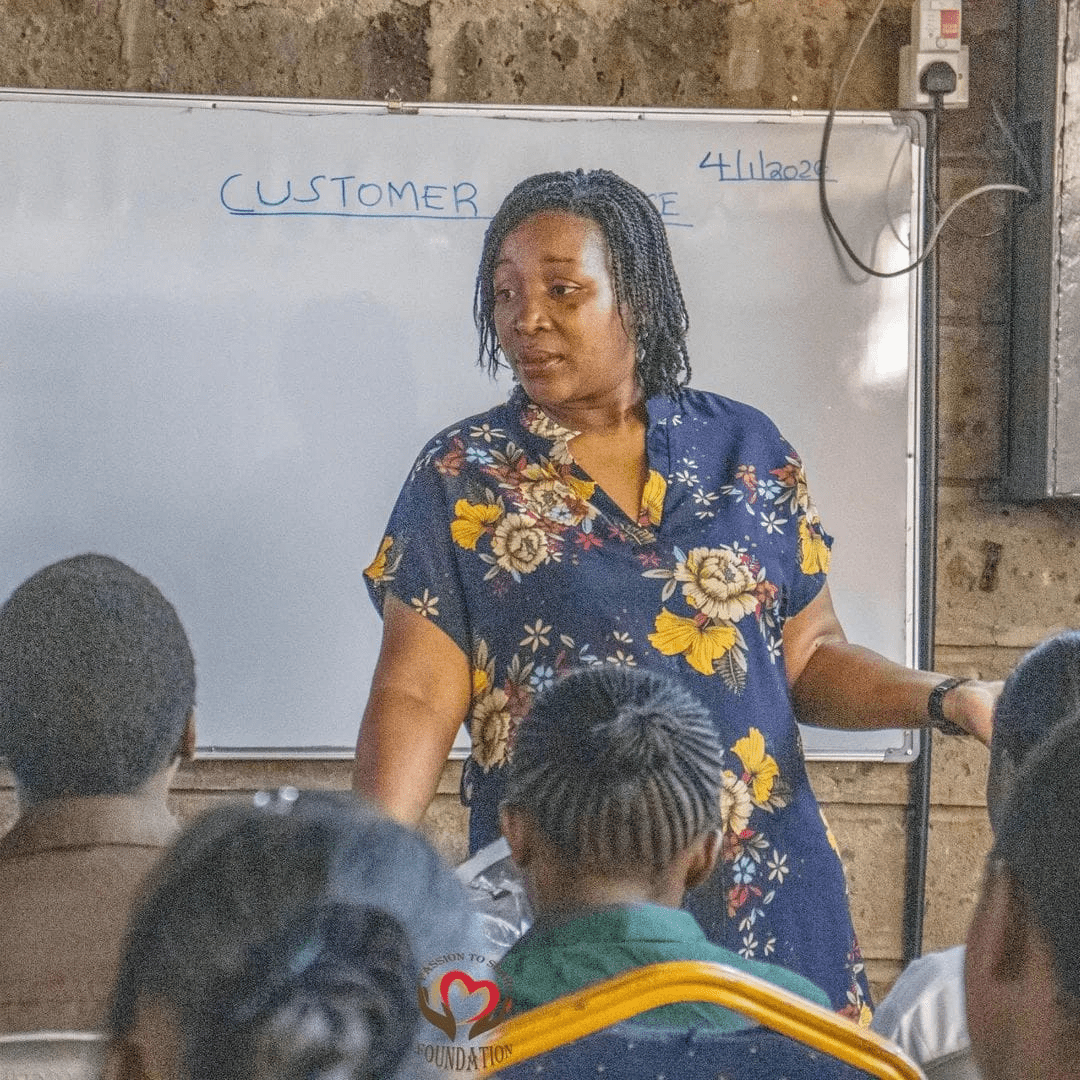
When Lydia Opiyo talks about Passion to Share Foundation, she does not begin with buildings, courses, or long-term plans. She begins with a moment—food shared, support offered, and families reached in times of need.
Founded in 2020, the organisation’s roots stretch beyond Kibera. Its earliest work involved supporting families affected by a devastating landslide in Bududa, Uganda. It was a painful encounter that revealed how small acts of kindness can carry deep meaning.
But it was a story closer to home that ultimately shaped its direction. During the COVID-19 pandemic, Lydia and her team met a young mother living in extreme hardship. She had to leave her daughter alone while she worked odd jobs to survive. The reality was stark, reflecting a broader pattern.
Across informal settlements, many girls complete secondary school only to find themselves with no clear path forward. Financial constraints, social pressures, and limited access to higher education often close off opportunities before they begin.
That reality fuelled Opiyo’s resolve to act.
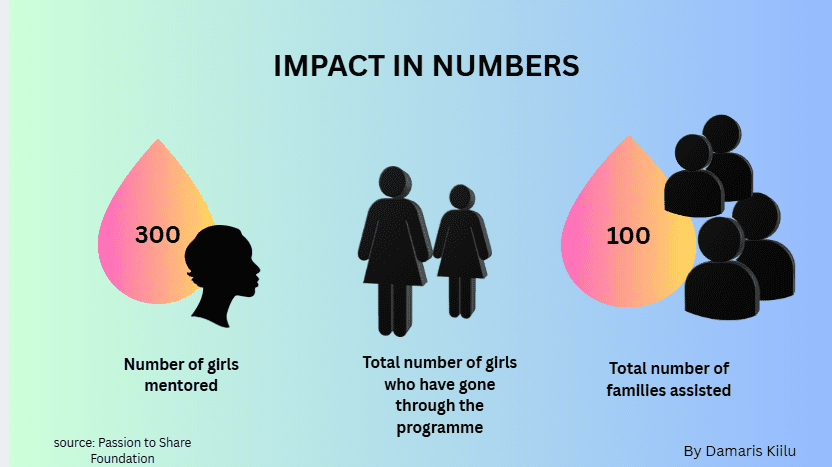
Today, the foundation supports over 300 girls, has mentored more than 1,000, and reached over 100 families—helping young women rebuild confidence, gain skills, and reclaim a sense of direction.
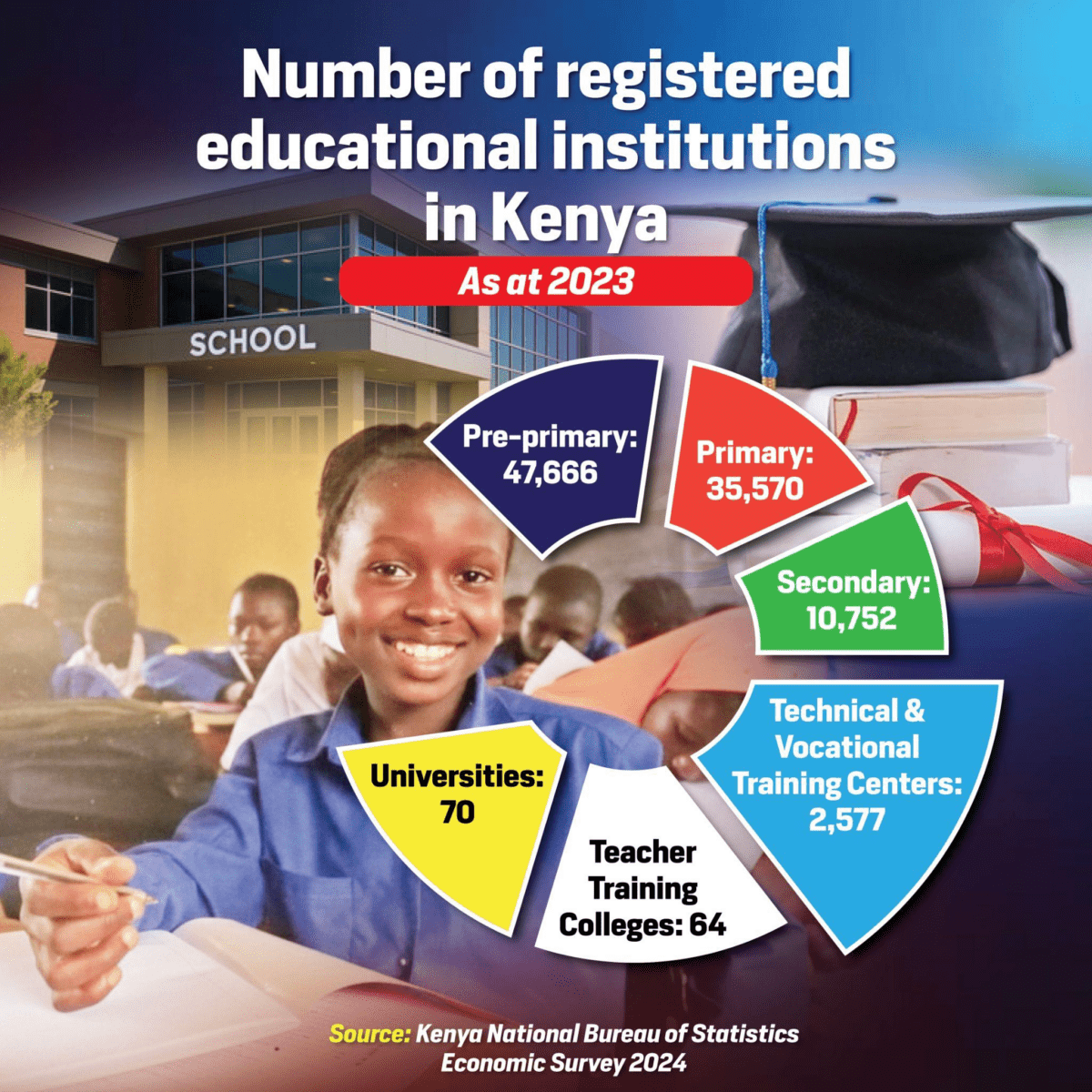
At a national level, the gap between education and opportunity is clear. According to the KNBS Economic Survey 2024, in 2023, Kenya had a total of 47,666 pre-primary institutions, 35,570 primary schools, 10,752 secondary schools, 2,577 technical and vocational training centres, 64 teacher training colleges, but only 70 universities.
While many children can access basic education, far fewer transition into higher learning. This disconnect reflects a broader structural challenge where education does not always translate into livelihoods, particularly for girls in informal settlements.
Solutions from within
In places like Kibera, these barriers are even more pronounced. Skills and mentorship programmes such as the Passion to Share Foundation offer a practical pathway to independence, helping to bridge the gap left by limited access to higher education.
Similar models are emerging across other organisations working in informal settlements. Initiatives like the Youth Impact Global Training Programme, led by Beryl Achieng of Success Afrika, demonstrate how targeted skills training and mentorship can transform outcomes for young people.
While distinct, these programmes share a common approach: combining mindset development with practical, market-relevant skills to build confidence, agency, and sustainable livelihoods.
Participants receive training in entrepreneurship, communication, teamwork, and problem-solving. These are skills that enable them to start businesses, secure employment, and contribute to their communities.
“The programme begins with mindset and confidence-building,” Beryl says, “recognising that many young people in informal settlements face low self-esteem, limiting beliefs, and social pressures that can block progress.”
“After developing the right mindset, participants move on to practical skills that match market needs—including financial literacy, business planning, and digital skills. These are reinforced through mentorship from experienced leaders who provide guidance, role models, and support to navigate challenges in business and life,” Beryl explains.
Over time, she says, participants become more proactive, independent, and capable of shaping their own futures. Many go on to start small enterprises in areas such as waste management, retail, and community services, while others secure formal employment.
For experts working in this space, the effectiveness of such programmes lies not only in what they offer, but in who leads them.
Women-led initiatives
Jane Anyango, a gender expert and Executive Director of Polycom Girls, says initiatives supporting girls and young mothers are most impactful when they are rooted in the communities they serve.
“These organisations are often led by women and girls who have experienced the same challenges. They are not just responding to problems—they are redesigning solutions from within,” she says.
She adds that young women are increasingly involved in shaping programmes, working alongside stakeholders, and even contributing to policy conversations.
The importance of practical skills is also reflected in the broader education landscape. With technical and vocational training centres far outnumbering universities, alternative pathways have become critical.
But beyond employability, these programmes offer something less visible and equally important: renewed agency. “Through skills training, girls are not only equipped for long-term opportunities, but they also regain a sense of purpose,” Jane explains. “Last year, we supported 20 young mothers to choose their own paths—some returned to school, others pursued vocational training. That choice alone begins to break the cycle of poverty.”
For many girls in settlements like Kibera, this combination of training, mentorship, and support opens doors that formal higher education often leaves closed.
Designed for change
At the Passion to Share Foundation, that idea has taken shape in practical ways. What began with just two courses has grown into a training centre quietly transforming lives. Today, the foundation offers programmes in Graphic Design, Fashion Design, Hairdressing, and Beauty Therapy—each designed to equip young women with skills they can use to earn a living and rebuild their futures.
For Lydia, the motivation behind this work is deeply personal. “I hated to see young girls engage in things like robbery and prostitution,” she says. “Not because they wanted to, but because they lacked options.”
She understands that lack of options firsthand. “Growing up in the slum is not easy,” Lydia says. “I came from a poor family where even basic needs like food were not guaranteed.”
When she meets the girls who apply to the programme, she often sees her younger self reflected in them. “When I meet this girl, I see the mini me. And I think—if I had not had this opportunity, my life would be very different.”
That memory continues to shape Lydia’s work. Today, the Passion to Share Foundation operates what she describes as a college-like institution, offering six months of fully sponsored skills training to vulnerable girls in Kibera.
Access to the programme is carefully managed. “We ensure that we give the opportunity to only deserving girls, and our recruitment process is very strict,” she says.
Applicants submit forms—either physically or online—before undergoing shortlisting, followed by oral and written interviews. “After that, we enrol only those who are qualified and ready,” Lydia explains.
The results, she says, are often transformative. “We have seen girls move out of the slums, earn an income, and pay their own bills. Others have completely changed after securing good jobs,” she notes. “Usually, a year after training, the girl no longer resembles the one who walked into the interview room.”
Fighting root causes
Yet sustaining that transformation comes at a cost. Funding remains the programme’s biggest challenge. “The cost per girl for six months is about Sh154,347,” Lydia says. Supporting a cohort of 44 girls at a time requires consistent donor backing, something that is not always guaranteed.
Beyond individual success stories, Lydia sees the programme as a response to broader structural realities in informal settlements. “I may not speak much about policy,” she says, “but what we are doing addresses key challenges—unemployment among women and girls, gender-based violence, and poverty.”
For her, the root issue is clear. “Poverty is an enemy we must fight with everything we have, especially in informal settlements.”
Her vision stretches well beyond the current programme. “We envision building the best women-only university in Kenya,” Lydia says—one that would go beyond skills training to address the full spectrum of challenges facing women, including access to childcare and financial support.
For many of the girls currently enrolled, that vision already feels within reach.
Experts say such approaches are essential. According to Jane, economic empowerment is central to breaking the cycles of vulnerability. “If young mothers are not economically empowered, they cannot make decisions for themselves. They rely on favours, which exposes them to exploitation and abuse,” she explains. “Economic independence brings hope, productivity, and growth—not just for the individual, but for the entire family.”
In many ways, this reflects a broader pattern seen across similar initiatives, where practical skills, mentorship, and mindset support combine to create lasting change.
Proof it works
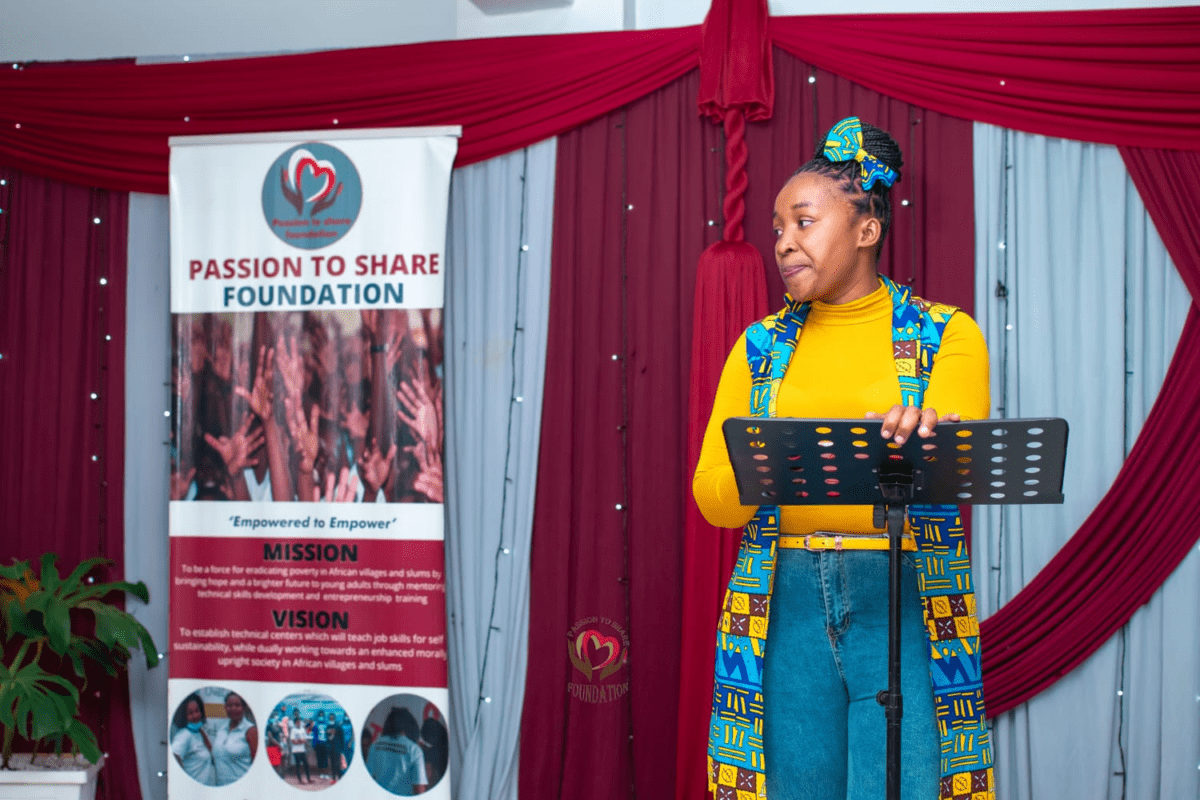
Charity Achieng Binge, now 22, is one of the programme’s beneficiaries and a member of its fifth cohort. Before joining the school, her life was marked by uncertainty. She had completed Form Four and carried big dreams, but had no clear path forward. “I dreamed of becoming a graphic designer, but I did not know where to start,” she says.
Raised by a single mother doing her best to provide, college fees felt out of reach. “At times, it felt like my dreams were too big for my situation,” she recalls.
That changed unexpectedly. One day, she met a woman distributing flyers for the Passion to Share Foundation and explaining the courses on offer. “She encouraged me to apply,” Charity says. “At that moment, something shifted.”
She followed her to the centre and submitted her application. “When I stepped into the institution, it felt like a dream unfolding right before my eyes.” Joining the programme gave her more than technical training. “It gave me hope, direction, and belief in myself again,” she says.
Charity enrolled in Graphic Design—a decision she says transformed her life. Alongside technical skills, she gained confidence, communication ability, and a clearer sense of direction. “Each of these skills shaped me in ways I never imagined. Where I once saw limitations, I now see opportunity.”
After graduating, her life took what she describes as “a beautiful turn.” She applied for a Graphic Design internship within the foundation and was selected, earning her first salary between 2024 and 2025.
She now works as a receptionist and graphic designer at the PSF Beauty School. “Today, I can confidently say my life has changed,” she says. She can support herself, contribute to her family, and assist in caring for her younger siblings. “I no longer feel helpless or dependent—I feel empowered.”
For Charity, the impact goes beyond income. “They didn’t just give me a skill. They gave me a job, dignity, and a future.” Her experience reflects a wider reality in Kibera, where many girls leave school with ambition but lack guidance and opportunity. “For many, the only options they see are early marriage or unsafe work just to survive,” she says.
She now hopes programmes like PSF can reach more girls facing similar barriers. Her journey underscores a broader gap faced by young women who complete school without access to further training or employment pathways.
Experts say mentorship plays a critical role in closing that gap. According to Jane, beyond technical skills, mentorship helps shape confidence, decision-making, and long-term life choices for young women.
Diana’s skills journey
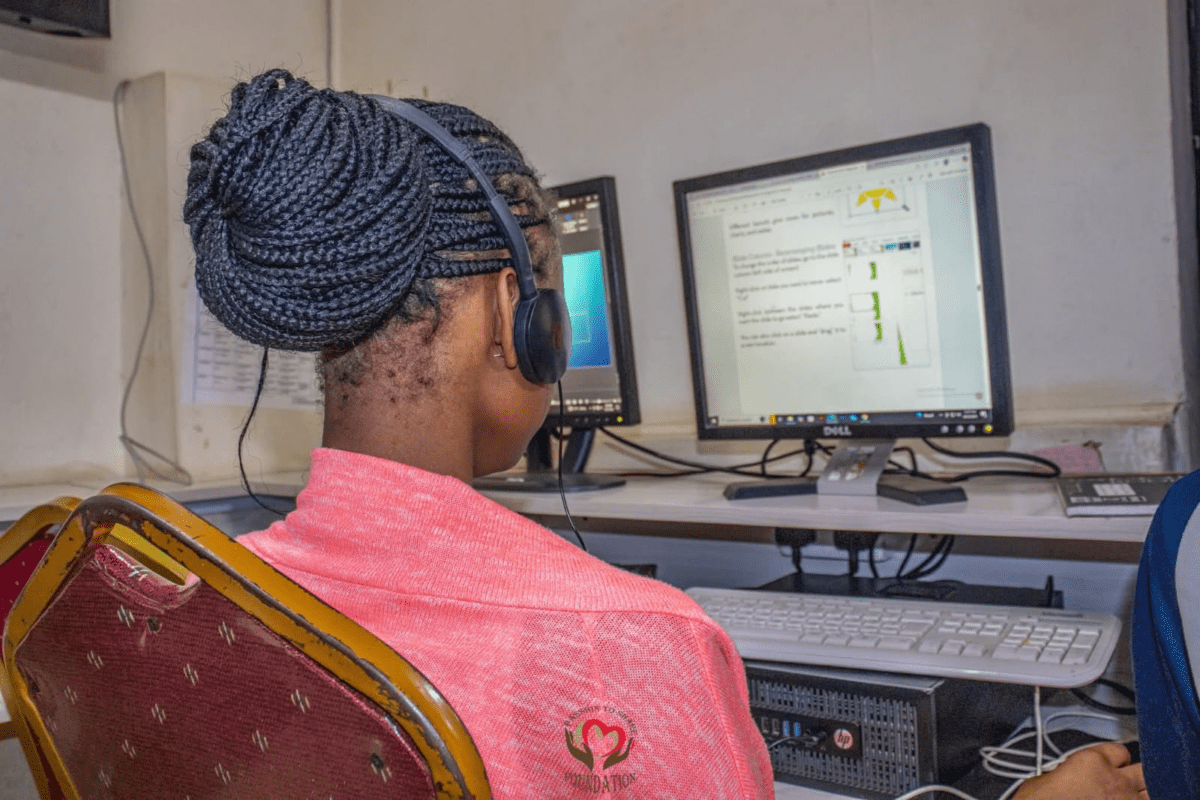
Diana Rakwach’s story follows a familiar pattern—one of waiting, uncertainty, and eventual renewal. After completing high school, financial constraints prevented her from joining college. She spent two years at home, taking on small, irregular jobs to support her family.
“During this time, I saw no light at the end of the tunnel,” she says. The Passion to Share Foundation, she recalls, appeared as “a beacon of hope.”
An advertisement for free courses caught her attention, particularly Fashion Design, which offered a way to turn her passion into something practical. Through the programme, she learned hands-on skills, from taking measurements and drafting patterns to cutting fabric and sewing.
Since completing the course, Diana says her life has shifted. The skills she gained helped her secure employment and meet her basic needs, while soft skills, such as customer service, opened additional opportunities.
Yet her journey also highlights the limits many young women still face. “Resources and opportunities are still limited,” she says. “I need more mentorship and guidance to become fully self-reliant.” That need for continued support reflects a broader reality: training alone is often not enough.
At the Passion to Share Foundation, programmes are designed to go beyond technical skills. Communication, mentorship, and peer support form a core part of the model.
Through its skills programme, communication is treated as a practical tool. Girls learn how to express themselves clearly, verbally and in writing, through real-life scenarios such as interviews, CV preparation, and workplace interactions. Non-verbal communication, including posture and confidence, is also emphasised.
The mentorship programme builds on this foundation. “At the Passion to Share Foundation, we believe skills alone are not enough,” the organisation notes. Girls and young mothers are paired with mentors who provide guidance, emotional support, and practical advice. Through both one-on-one sessions and group discussions, they learn to set goals, navigate challenges, and make informed decisions.
The mentorship extends beyond the training centre, reaching primary and secondary schools with messages of self-worth, education, and positive life choices. At the heart of the organisation’s work is a principle that predates its formal programmes: sharing.
The Passion to Share Foundation continues to provide clothing, food, and basic supplies to vulnerable communities in Kenya and Eastern Uganda, particularly during festive seasons such as Easter and Christmas. “That moment opened our eyes to a powerful truth: there is beauty in sharing,” the foundation says.
In Kibera, where opportunities are often limited and futures uncertain, that belief has taken shape in practical ways—through classrooms, sewing machines, and computer screens.
Evelyn’s Fashion journey
Evelyn Adhiambo spent three years at home after completing Form Four. With no clear path to college and growing pressure to support her family, she moved to Nairobi to live with her aunt and took up informal work selling fish by the roadside along Ngong Road. “Some days I earned Sh300, other days Sh100, and sometimes nothing at all,” she says.
For Evelyn, the experience was marked by uncertainty and survival. The Passion to Share Foundation offered a way out. Driven by her interest in fashion, she enrolled in the Fashion Design course, where she learned tailoring, fabric selection, and garment construction.
“I had asked my aunt to teach me before, since she is a tailor, but she never had the time,” she recalls. “So when this opportunity came, I took it.”
After completing the programme, Evelyn secured a three-month internship at TungaTunga, a fashion company in Hurlingham, before moving on to Miyo Creations, where she now works as head of production in the fashion department.
Today, her circumstances have changed significantly. She has moved out, rents her own space, and supports her siblings—two of whom finished form four and now live with her. “We manage what we have, but it is stable,” she says.
Her next goal is to open her own workshop, though she still needs essential equipment like an industrial overlock machine and some few dummies for showcasing clothes to get started.
For experts like Jane Anyango, such progress underscores the importance of economic empowerment. “When young mothers are not involved in decisions about their lives, programmes fail,” she says. “But when they are economically independent, they can challenge unfair treatment and break cycles of poverty and abuse.”
These realities are closely tied to broader structural gaps. Kenya’s education system continues to produce far more secondary school graduates than higher education can absorb. With only 70 universities compared to tens of thousands of primary and secondary schools, many young people complete their education with no clear pathway forward.
This imbalance places growing pressure on alternative pathways such as vocational training—especially for young women whose opportunities are further constrained by poverty, caregiving responsibilities, and social expectations.
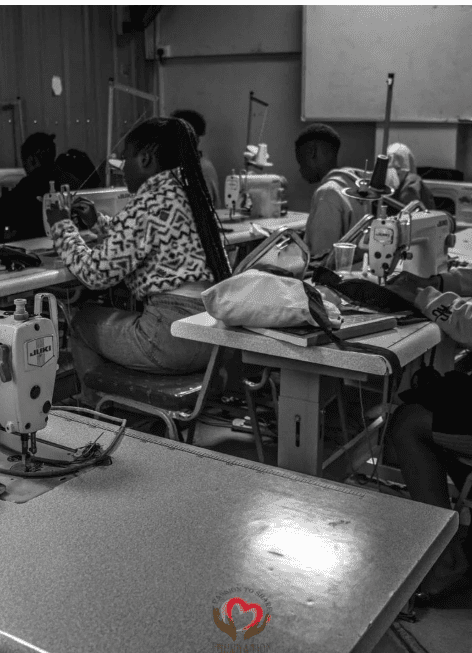
For girls from informal settlements such as Kibera—where poverty, caregiving responsibilities, and entrenched gender norms further constrict opportunity—the transition from school to stable employment is particularly difficult.
The Passion to Share Foundation positions itself within this gap, offering skills-based training, mentorship, and practical support as an alternative pathway to economic independence for those locked out of formal higher education.
This work reflects broader continental and national commitments. Under Agenda 2063 and the African Union’s Gender Equality and Women’s Empowerment Strategy, countries have committed to inclusive growth driven by women and youth—an approach that aligns with efforts to convert education into economic opportunity.
In Kenya, these priorities are reinforced by the Constitution (2010), which guarantees equality and non-discrimination (Article 27) as well as economic and social rights, including access to education and livelihoods (Article 43).
From a simple act of kindness to careers built skill by skill, Lydia Opiyo’s vision has grown into a quiet but powerful force. In Kibera, where finishing school often marks the beginning of uncertainty, the foundation is helping to reshape that reality—turning skills into livelihoods, mentorship into agency, and opportunity into lasting change.
The question now is whether such models can be scaled and sustained to reach the many young women still standing at the edge of that gap.

Leave a Reply