Reimagining Early Childhood Education in Ghana: AMO 30th Anniversary
In many Ghanaian classrooms, early childhood education has long leaned on memorization rather than experience. Young learners are often expected to grasp abstract concepts without the support of visual or tactile aids, a gap that has been rooted and transcended generations. Identifying the challenge within this space, AMO Program has carved its relevance over the past three decades, introducing a model where learning becomes something children can see, touch, and truly understand. Marking its 30th anniversary, the organization celebrated longevity, and a sustained intervention into one of Ghana’s most persistent educational challenges.
A child playing with AMO learning material
A Vision Born from a Child’s Struggle
The story of AMO traces back to a deeply personal moment in Abetifi in the Eastern Region of Ghana, where its founders encountered the very challenge, they would later dedicate their lives to addressing. When their son showed reluctance towards school, a closer look revealed a system lacking the visual and practical tools needed to make learning meaningful.
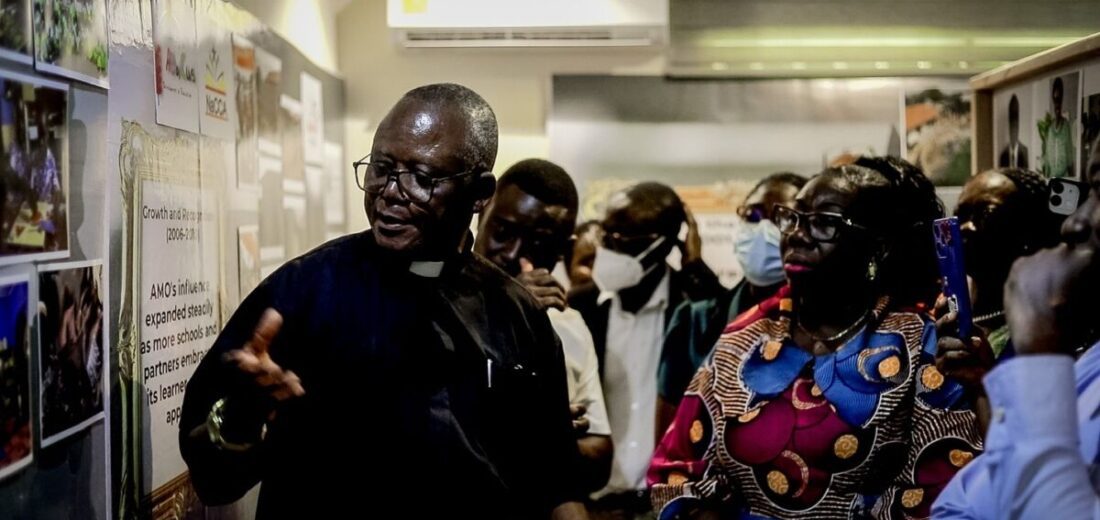
Rev. (Rtd.) Osafo Boateng, Co-founder, recounted this turning point during the anniversary celebration: “We realized that the problem was not the child, but the system. When a child cannot connect with what is being taught, learning becomes a burden rather than a discovery.”
What began as a response to a single child’s experience soon evolved into a broader mission to design learning materials that translate theory into practice. From handcrafted wooden models that simplify mathematical concepts like fractions, to structured approaches that promote active engagement, AMO began a revolution in Ghana’s education space.

Shaping Policy and Practice in Early Childhood Education
Beyond classrooms, AMO’s influence has steadily informed thinking at the institutional level. The Ghana Education Service recognizes the program beyond a supplementary initiative, it represents a shift in pedagogy.
Mrs. Adisa Tassa, Director of Early Childhood Education at GES, emphasized this impact: “What makes the AMO approach unique is its emphasis on active learning. It moves away from passive instruction and encourages children to interact with concepts in a way that builds deeper understanding and makes them independent.”
She noted that this methodology has significantly improved participation and retention among kindergarten pupils.

Regional Impact and Measurable Change
At the regional level, the results of AMO’s work are increasingly visible. Schools across the Eastern Region have reported notable improvements in both teaching delivery and student outcomes.
Mrs. Ivy Asantewa Owusu, Eastern Regional Director of GES, highlighted these gains: “We are seeing classrooms become more dynamic. Teachers are more confident, and pupils are more engaged. The difference is clear when you compare schools using AMO methods to those that are not.”
She pointed to specific outcomes such as improved learner participation and stronger foundational understanding in key subjects.

Transforming Classrooms, Empowering Teachers, Inspiring Learners
Within schools that have embraced the AMO approach, the transformation is profound. For tutors like Joselyn Ofori Okai, the shift goes beyond tools, it redefines the role of the teacher.
“AMO has changed how we teach. It is no longer about delivering information, but guiding learners to discover knowledge themselves,” she noted.
This approach produces educators who are more innovative and responsive, fostering environments where curiosity thrives. At the Abebotia Presbyterian primary School in the Eastern region, Headmistress Regina Korantemaa has observed the ripple effect of these changes. “Our teachers are more intentional in their methods, and the children are more confident and eager to learn,” she shared.
The impact has extended beyond academic performance, reflecting in a noticeable increase in school enrolment. “Parents are seeing the difference, and they want their children to be part of this experience,” she added.

Media, Advocacy, and Documenting Impact
As part of its ethical commitment to spotlight transformative and community-driven initiatives, Vice Versa Media Ghana played a key role in amplifying the significance of AMO’s 30-year milestone. Present at the anniversary celebration, we provided on-ground coverage of the event while also premiering a documentary that captured the depth of AMO’s impact across schools in various regions of Ghana. The documentary highlights the classroom transformations and also the network of partners whose sustained support has contributed to the program’s longevity. This effort reflects a broader mission to document stories that often unfold quietly yet carry national significance bringing visibility to solutions that are shaping the future of education

The Road Ahead: Expanding Access, Deepening Impact
As AMO marks three decades of impact, the focus now turns to the future, one that demands expansion, collaboration, and sustained commitment. For the leadership, the goal is to extend the benefits of active learning to every child across Ghana. Mrs. Theodosia Jackson emphasized this forward-looking vision: “We have built a strong foundation, but the work is far from over. The next phase must focus on scaling our reach and strengthening partnerships that will allow more schools to benefit from this approach.”
The call equally extends to the Ghana Education Service and other stakeholders to integrate and support such proven models at a national level. Because at its core, when children are given the tools to experience learning, education transforms from obligation into opportunity, shaping not just better students, but a more empowered generation.

Leave a Reply