How Ugandan Villages Are Mapping Their Own Future
The PIP approach is a farmer-led initiative that redefines how development projects engage with rural communities. Instead of treating farmers as passive recipients of aid, it places them at the centre of decision-making, innovation, and problem-solving. We had the opportunity to witness this in practice during a visit to one of the project areas in western Uganda.
Nestled in the breathtaking hills of Bunyangabu District, Bukara Village stretches across terraced fields and lush greenery, its winding paths weaving through steep, rocky slopes and rolling farmland.
On the horizon, the jagged peaks of the Rwenzori Mountains rise against the sky. We are here on a mission: to witness the Participatory Integrated Planning (PIP) approach firsthand, an approach that has reshaped the lives of this community.
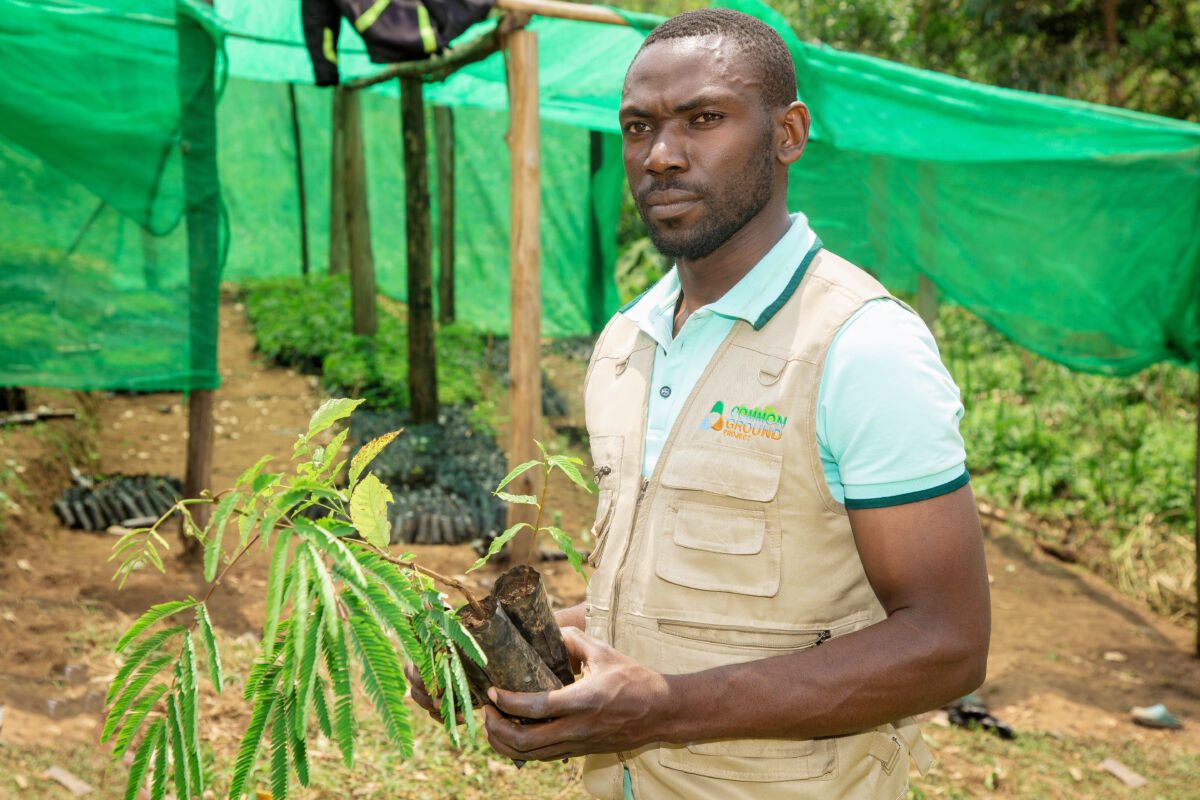
Our guide is Andrew Masinde, a former journalist with New Vision, Uganda’s largest newspaper, who now works with the Common Ground project. With a background in development studies, he has grown deeply fascinated by the PIP model.
‘The name itself holds three dimensions,’ he explains. ‘It is participatory because communities realise that challenges cannot be solved in isolation. One person cannot fix a broken road. But a hundred community members who all use that road can.’
The second element is integration: you must always have diverse activities on your land and in your household. ‘Make sure you do not grow only one crop on your land,’ Masinde advises.
‘Diversify with different crops, keep a few animals for manure to enrich the soil, and set aside part of your land for a kitchen garden. That way, you secure food for your family instead of buying everything from the market.’
And all this requires good planning. Communities chart their realities and aspirations through maps. Masinde explains: ‘People identify problems, such as water shortages, infertile fields, erosion, or even social conflict, and mark them on a village map.
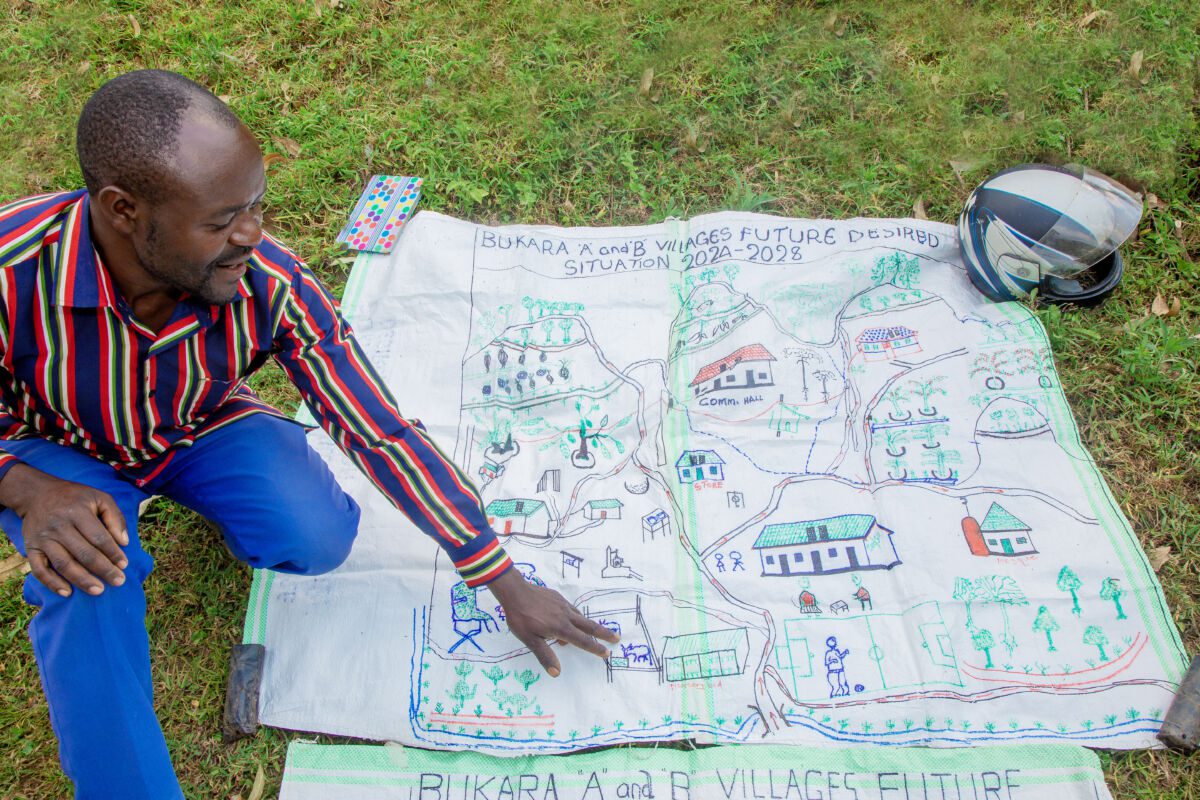
‘Then they draw a second map, one that reflects their ambitions for the next two to five years. For instance, a hillside now eroded can be reimagined with trees, ditches and grass. They mark out future sites for a tree nursery, a water source, or other improvements. That becomes the community PIP.’
There is also a household PIP, where a family (mother, father and children) identify both problems and aspirations within their household. ‘They draw their home and land as they are today,’ Masinde explains, ‘and then draw a second version showing what they want to achieve in the future.’
At the edge of the village, this process comes to life. A small nursery of coffee and tree seedlings has been established, where about twenty people have gathered to work and exchange ideas. The local district officer, Karungi Sillah Brenda, observes with quiet approval.
When the group finishes tending the seedlings, a large map is unrolled. Gideon Mubunga steps forward to demonstrate how the community PIP works. ‘I will present the vision of Bukara village for the period 2024–2028,’ he begins. ‘This drawing reflects our ambitions for the next four years, built around six pillars: hygiene, environment, livestock, education, agriculture, and market access.’
The rest of the group settles on a nearby hill, listening attentively as Mubunga continues. ‘As a community, we want to improve and maintain the roads and build a storage facility. This way, we will be less dependent on middlemen who buy our harvest at very low prices during peak season.
‘With storage, we gain more bargaining power. We are also seeking support for a coffee processing machine, so we can add value ourselves and fetch better prices in the market.’ He pauses, then points to another challenge: land degradation.
‘We plan to restore several critically degraded sites in our village by digging ditches and planting a variety of trees grown in our own nursery. This will stop erosion, reduce flooding, and in a few years, we will also have more firewood.’
In this way, Mubunga takes the community through the remaining pillars. ‘Bukara also needs a secondary school and a training centre where people can learn practical skills.
‘We have several primary schools, but the nearest secondary schools are far away. As a result, many students drop out before completing their education. A local secondary school and training centre would ensure continuity in education.’
Finally, he points to a clinic drawn on the map. ‘Health care is also a priority. The nearest clinic is in Rwajimpa, which is too far for many of us. We urgently need a health centre here in the village.’
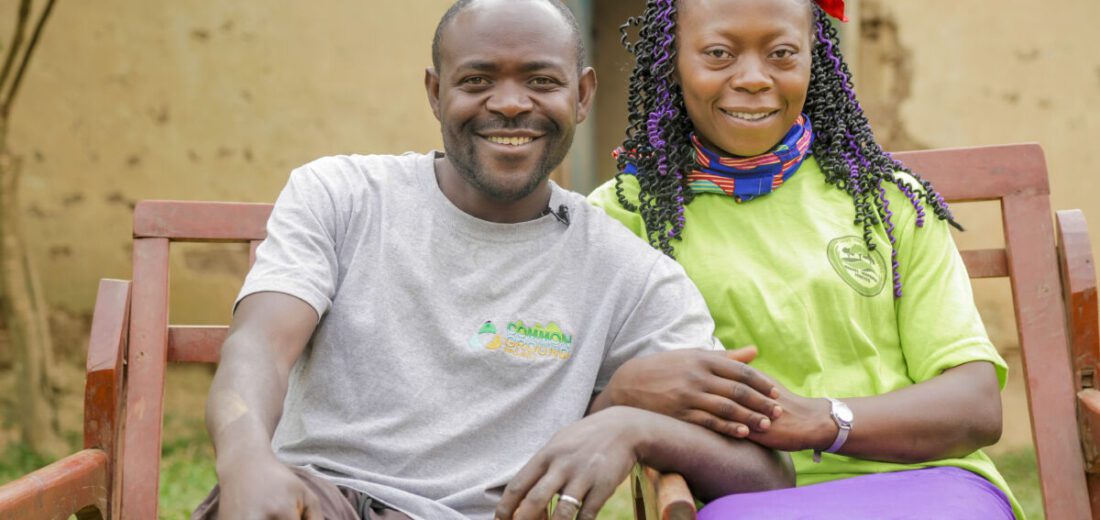
After the presentation, we joined Gideon and his wife, Maria Mubunga, for the walk to their home. The hilly terrain made it a strenuous journey, but their lively conversation lightened the path. Gideon and Maria radiate affection for one another; something not often displayed so openly in traditional Ugandan society.
‘We have been married for fifteen years and are still very much in love,’ Gideon says with a laugh when we remark that they look like a newlywed couple. Maria chimes in: ‘The secret of a good marriage is love, and we truly love each other. That is why we are still together. I love my husband because he is transparent and communicates well.’
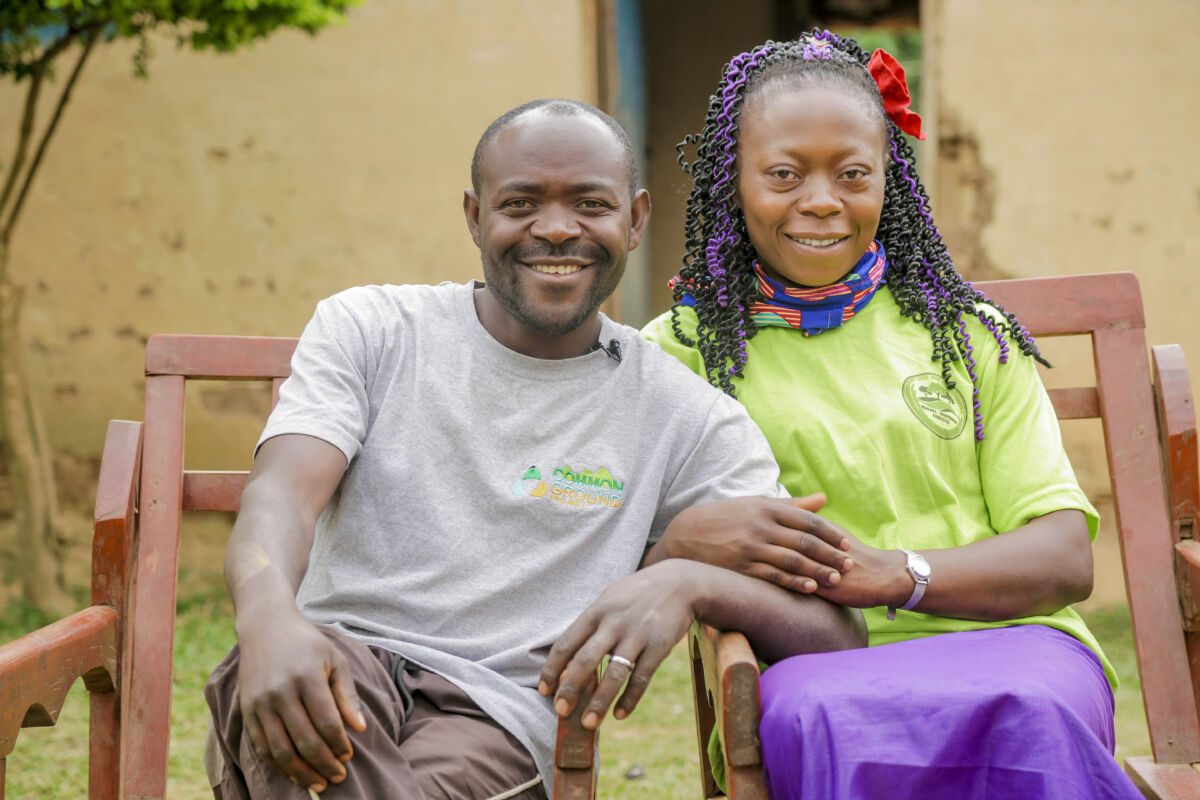
Seated in front of their house, Gideon recounts how they first became involved in the project. ‘Staff from Common Ground came to our community to introduce the PIP approach. They promised to return to train us, and they kept that promise. Since then, we have been inundated with new knowledge, from how to secure our livelihoods to better managing our small piece of land.’
Maria adds with a laugh, ‘Before this, our land was always full of weeds, and our harvests kept declining. We had no idea how to keep the soil healthy and productive.’
‘We have learned a lot,’ Gideon says. ‘Not only about agriculture and how to improve our crops, but also about sanitation, preventing land degradation, education, livestock, and even marketing our products. Most importantly, we were trained to create a vision and plan together. Now we have common goals we want to achieve as a couple.’
Maria nods in agreement. ‘Before the PIP approach, everyone in this house did their own thing. We never worked together as a family. Through the training, we learned what it means to plan and act together, and how much that can improve our lives. Now we manage the farm as a team and even handle our finances together.
‘We also make plans for the future, like the small building we want to put up next to our house to sell products. We have already started making bricks. We even installed electricity so the children can watch television. I am convinced that with the extra income from our farm, we will be able to send them to boarding school.’
Karungi Sillah Brenda, the sub-county chief of Bukara, is a young professional in her second job, originally from Fort Portal. Appointed by the government, she speaks with great affection about her posting.
‘The moment I came here, I embraced the place and was ready to serve. I love regions with many hills and valleys. There is a saying among the people here: Bukara is hard to reach, but easy to stay. That is why I have already been here for one and a half years.’
The project has added an extra dimension to her work. ‘What I find beautiful about the PIP approach is that it truly involves the community; it is an empowering approach. It has made my work much easier. When I started this job, the project had just been launched.
‘At first, I thought it would be a waste of time and money, but now I am very enthusiastic about it. Even people who have never been to school can explain how the PIP approach works and how they have benefited from it.
‘The project has played a crucial role in the transformation of our community. People now see the value of education, add value to their crops, understand their priorities, negotiate for what they need, and work together toward their goals,’ she says.
Her initial scepticism had clear roots. ‘In the past, projects were designed from above, without consulting the community. Many of these expensive projects failed because people did not feel connected to them, and there was no sense of ownership.
‘The PIP approach is different—it starts with the community itself. People decide what should happen, where, and how. They take action for themselves instead of waiting for an organisation to step in. This makes the process sustainable. If you return here in five years, the knowledge will still be with the community, and people will have something to show that they are proud of,’ she states.
From there, we make another tough climb to visit the home and land of Sharon Kabu. Unlike many others in Bukara, she is not an original resident of the village but came from Kasese, a district capital at the foot of the Rwenzori Mountains.
A few years ago, she and her husband moved to Bukara. ‘We could no longer afford the rent in the city,’ she explains, ‘so we looked for a small piece of farmland we could buy with our savings. That is how we ended up here.’
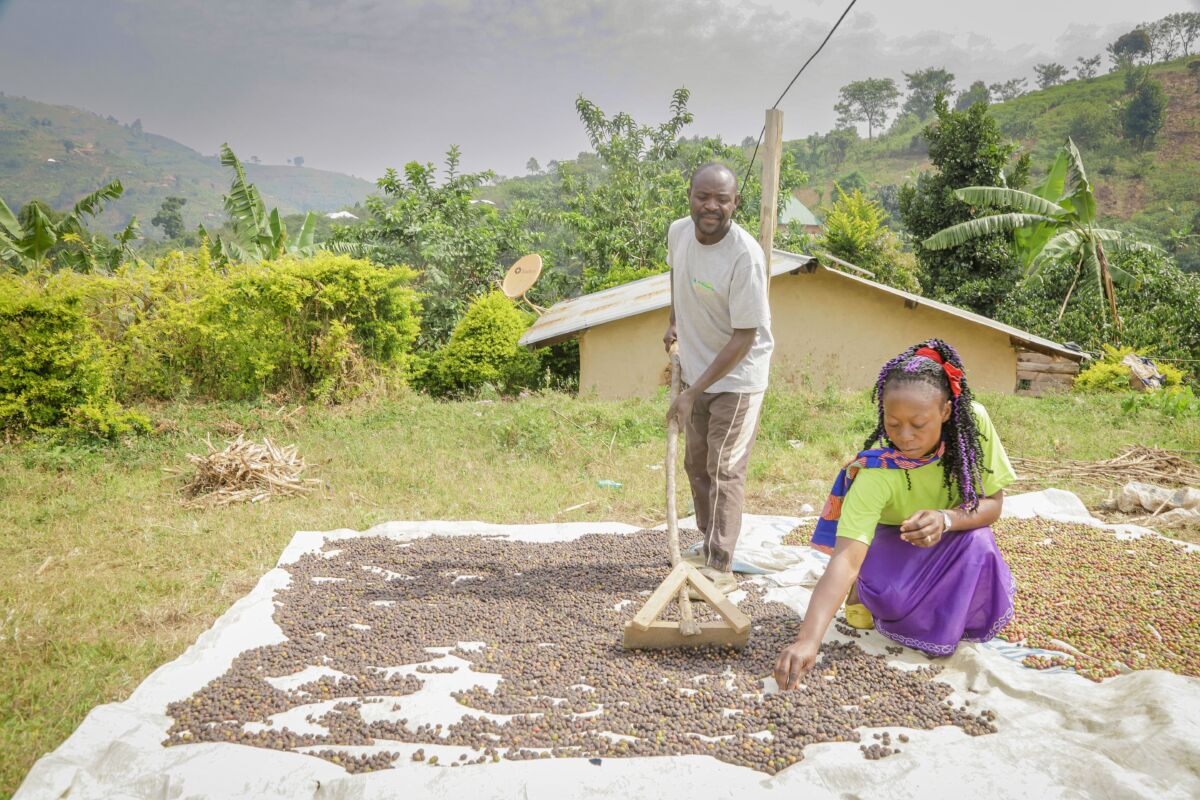
Sharon has quickly adapted to her new life in Bukara. ‘The people here are hospitable. We easily became part of the village,’ she says with a smile. What she values most is the strong sense of community.
‘People work well together, especially on issues that affect everyone. Because of this, the potential of the community is being tapped more and more.’
Kabu was among the PIP innovators—the first group of thirty farmers in the village who underwent an intensive six-month training in vision planning and improved farming practices. These pioneers play a vital role in spreading the knowledge further.
Each innovator is responsible for training ten other villagers, usually neighbours and friends, through farmer-to-farmer sessions. Within a year, this ripple effect creates around three hundred PIP farmers in a community, often the majority of households. This critical mass becomes the driving force behind implementing the PIP plans made by the community.
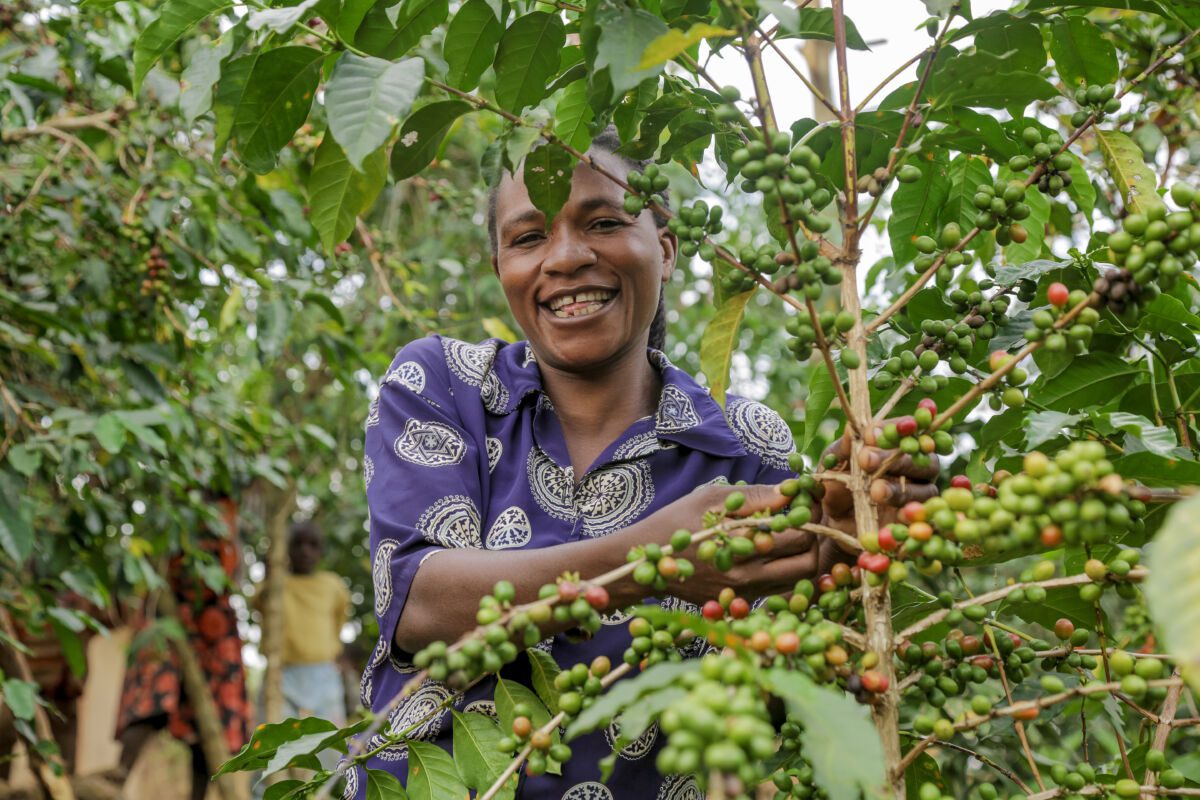
When asked why she signed up for the very first group of thirty PIP farmers, Sharon explains: ‘My husband and I have a background in agriculture. When I heard about something called a Participatory Integrated Plan for the farm, my interest was immediately aroused—especially because it involved integrating different crops on the same land.
‘That was new to us. Out of pure curiosity, I joined the training. What struck me was how concrete it was: in one session, we identified our problems together and immediately began discussing causes and solutions.’
The training has since opened her eyes to new possibilities. ‘We learned how to conserve soil and water by digging trenches and planting trees. I also picked up techniques like pruning coffee and banana plants. If our coffee and bananas bring in a good income, we plan to buy an extra piece of land for bananas. After that, we want to build a permanent house.’
It is, above all, a matter of mentality—approaching problems with a new mindset. She says, ‘Our way of thinking has really changed. I can now confidently make a detailed plan for our household: what has to happen, how it has to happen, and where it has to happen.’
She also takes pride in sharing her knowledge with others. ‘I have trained ten fellow residents in how to create a PIP and how to work together as a family with common goals. Now they, too, have started digging trenches to control erosion and are pruning their coffee plants.
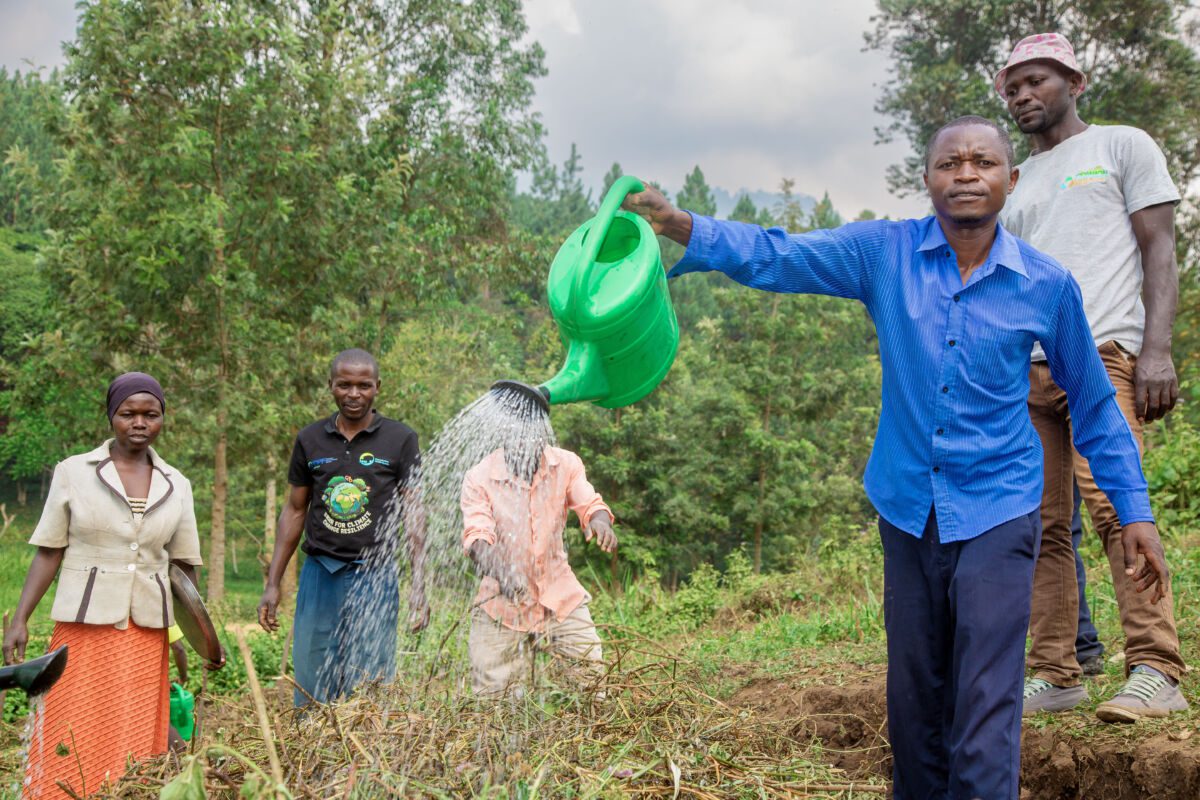
‘I first invited them to our home to show what I had done and how it had brought change. After that, it was easier to train them to apply the PIP in their own households.’
We walk across her land, carefully navigating the steep slopes, steadying ourselves on coffee shrubs and banana trees to keep from slipping. Sharon points proudly to a pig rooting around in the garden.
‘With the proceeds from our first harvest, I was able to buy this pig. With the next harvest, I will buy more. The pigs provide manure for the coffee plants, which means even more income.’
As we take our leave, she reflects with a smile: ‘I do not miss the city life I used to have. Here, I earn more, and we can provide for our livelihoods much better.’
We visit several other families whose stories echo those of Gideon and Maria Mubunga and Sharon Kabu. Andrew Masinde has watched closely, listening with interest. ‘It is so beautiful to see communities changing,’ he says.
‘People now work together much better, even within households. They are really changing their mindset, or rather, building a new way of thinking. By making a plan, the PIP, people become motivated; they realise they can do things themselves and do not have to wait for the government.
‘And if a man wants his household to grow, he must actively contribute instead of leaving everything to his wife. If you want to change a community, you must first change the mindset.’
This shift does not stop with households alone; it also reshapes leadership. ‘At first, local leaders sometimes resisted,’ Masinde explains. ‘They were used to projects that distributed money or resources—seedlings, chickens, that kind of thing. In Common Ground, communities do not receive free handouts.
‘But when leaders saw how much people were changing, they too began to support the project. What we are doing is truly a bottom-up approach. People become aware of their problems, then make an integrated plan together—whether as a village or as a family—and start with what they can do themselves.’
He continues, ‘If a project keeps giving handouts, people stop the moment the project ends because they have become dependent. But this approach encourages them to act, to take ownership of the changes, and to take responsibility for their community and household.’
He adds that once the mindset shifts, the results endure. ‘When people are motivated, they keep maintaining the roads, restoring degraded hills, planting trees, and keeping their land healthy—even without the project.
‘Tree nurseries also last because the communities themselves set them up. We encourage them to turn these into enterprises that can generate income. That way, something remains even after the project has ended.’
Box
The Dutch researcher Aad Kessler developed the Participatory Integrated Planning (PIP) approach, designed to motivate farmers and other stakeholders to commit to sustainable land management and landscape restoration.
Kessler, a sustainable land management researcher at Wageningen University, first shaped the concept during a decade of work in the Andes region of Chile, Peru, and Bolivia.
Today, the PIP approach has spread beyond Latin America and is being applied in Uganda, Burundi, the Democratic Republic of Congo, Ethiopia, and other countries.
‘Many development projects fail because they are designed in a top-down way, not rooted in local needs, and people are simply told what to do,’ Kessler explains. ‘Often, farmers take part only because they receive something in return, not because they truly believe in the process.
‘The PIP approach reverses this logic: communities take the lead. By raising awareness and mapping out their future visions, they can articulate what they actually need and plan for the long term.
‘This shifts the focus from short-term fixes to sustainable solutions. PIP farmers also become better stewards of their land, understanding that healthy soils are the foundation for the future of their farms.’
‘We can also learn a great deal from this approach in the Netherlands,’ Kessler reflects. ‘Especially the importance of long-term thinking and visualising a shared vision of how our future can be better.
‘Here too, we need to cultivate a mentality of working together toward common goals and collective plans. The way the PIP approach fosters that sense of togetherness for a more sustainable future in African countries is something we can certainly draw inspiration from.’
In Uganda, the project is carried out by Common Ground, active in both the eastern and western regions of the country. It is financed by the Embassy of the Kingdom of the Netherlands and implemented by Integrated Seed and Sector Development Uganda (ISSD Uganda) and Wageningen Environmental Research (WENR), in collaboration with local partners JESE, AID, Caritas Kabale, and A2N Uganda.

Leave a Reply